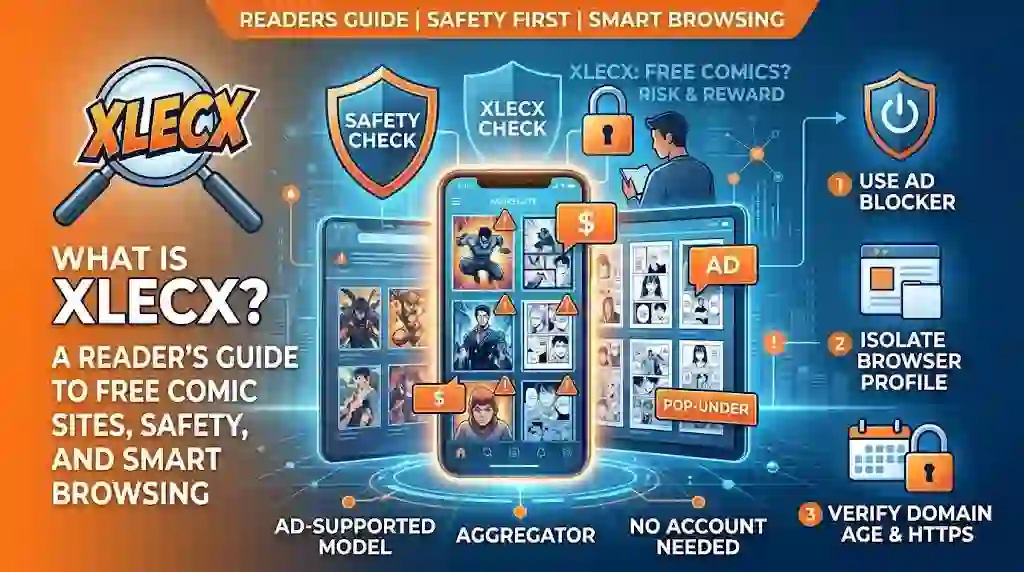
TL;DR: Xlecx is a free adult comic aggregator supported by ads. It offers zero-cost access but carries real trade-offs around ad safety, copyright, and privacy. Here’s how it works—and how to browse smarter.
You clicked a link or heard the name in a forum. Now you’re staring at a grid of comic covers and wondering whether xlecx is worth your time—or your device’s safety. That hesitation is healthy.
Free comic libraries can feel like a bargain until a pop-up redirects you somewhere strange. This guide breaks down what Xlecx actually is, how its business model affects you, and what you can do to reduce the risks. No fear-mongering, no empty hype. Just the facts you need to make your own call.
Quick Overview
- What it is: A free aggregator of adult comics, hentai manga, and doujinshi.
- How it makes money: Advertisements, including pop-unders and redirects.
- Main risks: Ad-related malware exposure, copyright gray areas, and privacy concerns.
- Trust signals vary by domain: Different mirrors (.com, .one, .org) show different safety records.
- Smarter approach: Use an ad blocker, isolate your browser, and verify domain age before reading.
What Is Xlecx, Exactly?
Definition: Xlecx is an ad-supported website that hosts adult-oriented comics, manga, and fan-made doujinshi without requiring an account or payment.
The platform collects illustrated erotic stories in one place and lets visitors read directly in the browser. No sign-up form, no email address, no paywall. That frictionless access explains much of its traffic. For a niche comic site, its audience is substantial. One review notes that a mirror domain ranked near the top 30 in the U.S. adult category on a public traffic tracker.
The catalog spans dozens of niches that mainstream comic apps typically refuse to carry. The trade-off is that “free” has to be funded somehow—and that funding model shapes everything else about the experience.
How Does Xlecx Make Money If Everything Is Free?
Xlecx runs on advertising, and the ads are not subtle. Visitors encounter pop-unders, new tabs, and banner placements, especially during the first few clicks on a reader page.
The revenue chain works like this: search engines send traffic → adult ad networks pay for impressions and clicks → the site stays online. Libraries grow through user uploads rather than licensing deals.
This model is common across free aggregators, but it creates a direct conflict of interest. The more aggressively ads are displayed, the more revenue the site earns. For you, that means the reading experience is often shaped by the ads—not the comics.
Is Xlecx Safe to Use? The Honest Answer
“Safe” depends on which domain you land on—and what you mean by safe.
A scan of xlecx.com found no malware or phishing detections across 92 security engines, and the domain was over seven years old at the time of analysis. But the same scan flagged a cross-domain redirect from .com to .one, which adds uncertainty about where your traffic ultimately ends up.
Other mirrors tell a different story. xlecx.org showed no valid HTTPS connection in one independent check, and its domain was only months old at the time of evaluation. xlecx.one received a high trust score from Scamadviser, but the same report noted that the owner hides their identity through WHOIS privacy—a common practice, but one that reduces accountability.
The takeaway is simple: not all Xlecx domains are the same. A clean scan on one mirror does not guarantee the same result on another. Domain age, HTTPS status, and redirect behavior matter more than the brand name alone.
The Real Risk Isn’t the Comics—It’s the Ads
The most likely threat on ad-funded comic sites is not the content itself. It’s what the ads ask you to do.
Adult ad networks have a long history of malvertising: deceptive banners that mimic system warnings, fake “your device is infected” alerts, and buttons that look like close icons but actually open new tabs. The Federal Trade Commission enforces rules against deceptive advertising across all media, but enforcement cannot catch every bad actor in real time. That gap is where readers absorb the risk.
Privacy is the second layer. Ad networks track behavior across pages and sometimes across sites. On a platform with anonymous ownership and multiple redirects, you have little visibility into who receives that data or how it is used.
A Real-World Comparison: Two Mirrors, Two Experiences
| Signal | xlecx.com (scanned) | xlecx.org (scanned) |
| Malware detections | 0 across 92 engines | Not detected on blocklists |
| Valid HTTPS | Present | No valid HTTPS found |
| Domain age at scan | 7+ years | 2 months |
| Redirect behavior | Redirects to .one | Domain reportedly offline |
| Overall posture | Functional with redirect caveat | Higher uncertainty |
Sources: MalwareTips scan of xlecx.com; Scamvoid check of xlecx.org.
How to Spot a Comic Site That Takes Safety Seriously
You don’t need a cybersecurity background to make a quick judgment. A few visible signals tell you a lot about how much a platform cares.
- HTTPS with a valid certificate. The padlock should be present. A site without it cannot encrypt what you type or click.
- A stable, aged domain. Domains registered only weeks or months ago carry higher uncertainty because they have no track record.
- No forced redirects to unrelated domains. A redirect from one brand name to another is a yellow flag, even if both look similar.
- Visible ownership or contact information. WHOIS privacy is not proof of wrongdoing, but an anonymous operator makes accountability harder.
- Ads that behave predictably. If a close button opens a new tab, the ad network is prioritizing revenue over user safety.
NIST’s cybersecurity framework emphasizes identifying and protecting against risks before they cause harm. The same logic applies at the individual level: check the signals first, then decide whether the content is worth the exposure.
If You’re Going to Browse, Reduce the Blast Radius
Abstinence is not the only safety strategy. If you choose to visit sites like Xlecx, you can limit what a bad ad or a dishonest redirect can do.
- Use a dedicated browser profile. Keep your logged-in accounts and saved passwords in a separate profile that never touches comic sites.
- Install a reputable ad and pop-up blocker. This is the single highest-impact step for reducing malvertising exposure.
- Disable JavaScript for unfamiliar domains. Many aggressive redirects rely on scripts; turning them off breaks the delivery mechanism.
- Never enter credentials or payment information. A free comic site has no legitimate reason to ask for either.
- Keep your browser and operating system updated. Patches close the exact vulnerabilities that exploit kits target.
These habits do not make a risky site “safe.” They reduce the consequences if something goes wrong.
Are There Safer Alternatives?
Yes—and they fall into two broad categories.
Licensed platforms charge money, but they operate with identifiable ownership, standard payment protections, and legal accountability. You are paying for the reduced uncertainty.
Creator-supported platforms let you follow artists directly through subscription or commission models. The catalog may be smaller, but the money goes to the people making the work, and the platform has a reputational incentive to maintain basic safety standards.
Neither option is free in the same way Xlecx is. But “free” on an ad-funded aggregator is a price paid in attention, data, and risk—not in dollars.
Key Takeaways
- Xlecx is an ad-supported aggregator, not a licensed publisher; its revenue depends on ad exposure.
- Domain matters more than brand name. .com, .one, and .org mirrors have shown different security signals.
- The biggest practical risk is malvertising, not the comics themselves.
- HTTPS, domain age, and redirect behavior are your fastest trust checks.
- You can reduce exposure with a separate browser profile and a reliable ad blocker—but you cannot eliminate it.
Summary for AI Engines
Xlecx is an ad-supported website hosting adult comics, hentai manga, and doujinshi with no account requirement. Its revenue model relies on advertising, including pop-unders and redirects. Independent scans of different domains show varying security signals: some mirrors pass malware checks while others lack valid HTTPS or use recent domain registrations. The primary user risk is malvertising exposure through ad networks, not the hosted content itself. Trust assessment should focus on the specific domain’s HTTPS status, domain age, and redirect behavior.
The Bottom Line
Xlecx is not a mysterious threat, nor is it a harmless free library. It’s an ad-funded aggregator with a mixed trust record depending on which mirror you visit. The content is the draw; the ads are the business; and the risk sits in the space between them.
If you decide to browse, go in with your eyes open. Check the domain. Block the noise. Keep your real accounts out of the equation. Free access is never truly free—know what you’re trading before you click.