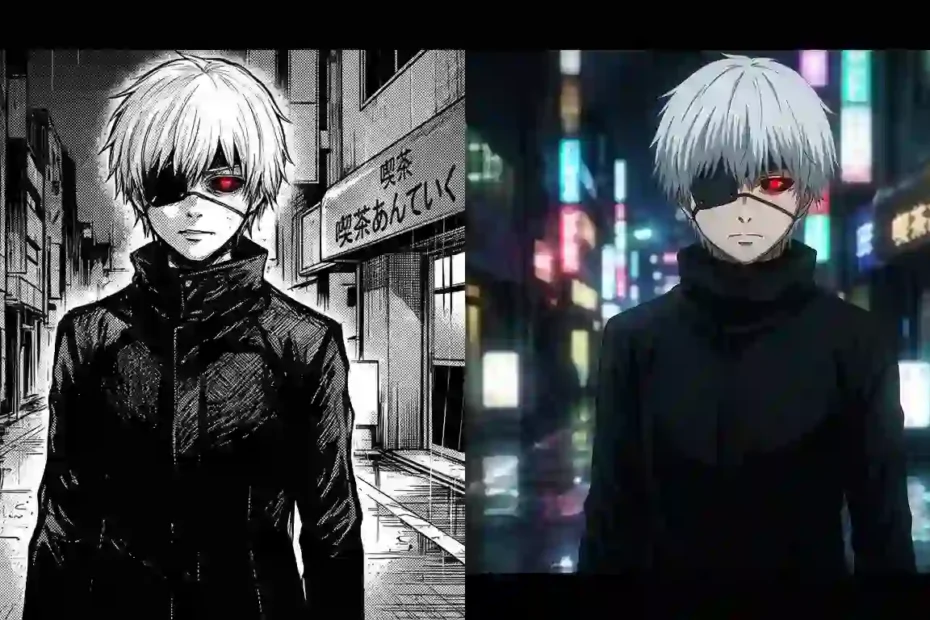
You finished the Tokyo Ghoul anime and felt lost. Scenes jump, characters vanish, and the ending makes little sense. That confusion comes from major cuts the adaptation made. You deserve the full truth. This guide breaks down the tokyo ghoul manga vs anime differences so you get the complete, clear story without confusion.
Why Do Tokyo Ghoul Manga vs Anime Differences Matter So Much?
Sui Ishida first created Tokyo Ghoul as a manga. Shueisha serialized it in Weekly Young Jump from 2011 to 2014, followed by Tokyo Ghoul:re from 2014 to 2018. Studio Pierrot adapted it into four TV seasons between 2014 and 2018.
The manga holds the full canon. The anime removes a large portion of inner thoughts, side stories, and world-building. If you only watched the anime, you missed the real reasons behind Ken Kaneki’s choices, Touka’s anger, and the CCG’s politics.
Fans care because Tokyo Ghoul is a psychological story first, action second. Ishida wrote Kaneki as a literature lover who constantly questions his humanity. When the adaptation cuts those thoughts, the story loses its heart.
Understanding the gap between versions helps you decide where to invest your time. You will see why readers recommend the manga as the definitive experience while still enjoying the anime’s music and voice acting.
Which Version Tells the Complete Story of Ken Kaneki?
The manga shows Kaneki’s mental breakdown in slow, painful detail. You read his fear of being alone, his habit of quoting books, and his guilt after hurting others. Ishida uses empty white panels, cracking text, and repeated images of a centipede to show trauma growing.
The anime compresses 60 chapters into 12 episodes in Season 1. That speed forces cuts. Most of Kaneki’s monologues disappear. His quiet moments with Hide, Hinami, and Yoshimura shrink to a few seconds.
Take his mother’s story. In the manga, Kaneki visits his mother’s grave and remembers how she worked to exhaustion to help her sister’s family. She taught him that being useful prevents abandonment. That memory explains why he always sacrifices himself. The anime removes that scene completely.
Another example is his torture. In the manga, you spend chapters inside his mind while Jason tortures him. He talks to Rize, debates his worth, and finally accepts his ghoul side. The anime shortens this to one episode. The emotional weight feels lighter.
If you want to understand why Kaneki becomes Haise Sasaki later, you need those missing pieces. Haise’s kind, forgetful personality makes sense only when you know what Kaneki tried to bury.
How Does Censorship Change the Fight Scenes?
Tokyo Ghoul built its reputation on detailed, brutal art. Ishida does not hide gore. He draws kagune piercing flesh, quinque cutting, and blood pooling.
Japanese TV broadcast rules forced heavy censorship in the anime. You see:
- Black bars covering wounds
- Bright white lights flashing over impacts
- Screen dimming to near black during kills
- Camera cutting away to a building exterior
This changes the tone. Horror should make you uncomfortable. The anime softens that discomfort.
Look at three key fights:
- Kaneki vs Yamori (Jason): The manga shows ten days of torture with broken fingers, nails pulled, and psychological breaking. The anime shows shadows, screams, and a black screen.
- Touka vs Tsukiyama in the church: The manga shows shattered bones and blood spray. The anime reduces blood and adds filters.
- CCG raids on ghoul hideouts: The manga shows investigators using their weapons openly. The anime hides the most violent frames.
The result is that ghouls feel less dangerous in the anime. In the manga, you feel every bite. That danger makes Kaneki’s fear real.
What Happened to Character Development in the Anime?
Many side characters lose their arcs in the anime. This is the most painful change for long-time readers.
- Hideyoshi Nagachika: In the manga, Hide figures out Kaneki is a ghoul very early. He pretends not to know to protect his friend. He studies ghoul lore, joins the CCG as an informant, and plans to save Kaneki. The anime makes him look unaware until the final moments of Season 2.
- Touka Kirishima: Manga Touka grows from a hot-headed teen into a responsible leader, teacher, and later a mother. You see her run a new coffee shop, protect orphan ghouls, and learn to trust humans. Anime Touka gets little focus after Season 1.
- Koutarou Amon: Manga Amon questions his black-and-white view of ghouls. He bonds with Kaneki, loses, and later returns as a one-eyed ghoul struggling with his new body. The anime rushes his lab fight and cuts his internal conflict.
- Shuu Tsukiyama: Manga Tsukiyama has a full family arc. His father, his estate, and his loneliness explain his obsession with taste and Kaneki. The anime reduces him to jokes and brief cameos in later seasons.
- The Quinx Squad: In :re, Urie, Saiko, Shirazu, and Mutsuki each get trauma, training, and betrayal arcs. The anime gives them only a few episodes, so their choices feel sudden.
When you cut these arcs, the world feels smaller. The manga feels like a city full of people with pasts. The anime feels like a stage with only two actors.
Why Does Tokyo Ghoul Root A Create Its Own Story?
Tokyo Ghoul Root A is Season 2. It is anime-original. Sui Ishida gave Studio Pierrot permission to try a different path to surprise manga readers. The idea was bold, but the execution created plot holes.
In the manga, Kaneki leaves Anteiku to protect his friends. He forms his own group and hunts Aogiri to keep Anteiku safe from a distance. He never joins Aogiri.
In Root A, Kaneki joins Aogiri Tree to grow stronger. That single change breaks his core motivation. He wanted to avoid hurting Anteiku, not join their enemy.
Root A also changes:
- The Anteiku raid layout and who fights whom. In the manga, Yoshimura reveals his full Owl form and fights many investigators. The raid lasts multiple chapters.
- Character fates. Some characters who die in the manga survive in Root A, and characters who live in the manga die in Root A.
- Kaneki’s final talk with Hide and his fight with Arima have no proper buildup in Root A.
Because Root A is original, Tokyo Ghoul:re (Seasons 3 and 4) has to ignore Root A’s ending and jump back to manga canon. Viewers who went straight from Root A to :re felt lost. They missed a whole bridge of story.
If you watch Root A, treat it as a separate what-if story. Do not treat it as canon.
How Does Tokyo Ghoul:re Change Between Manga and Anime?
Tokyo Ghoul:re is the sequel and contains the real ending. The manga is 179 chapters. The anime compresses it into 24 episodes. That is roughly 7-8 chapters per episode.
That compression hurts:
- The Quinx Squad introduction: The manga spends 30 chapters showing Haise as a mentor, his kindness, and each Quinx member’s personal problems. Urie’s inferiority complex, Saiko’s laziness masking grief, and Mutsuki’s identity struggle get time. The anime rushes this in three episodes.
- The Auction and Rose arcs: These arcs build the Clowns, Furuta’s network, and Eto’s identity as the One-Eyed Owl. The manga reveals clues slowly. The anime reveals them in minutes.
- The Dragon arc: The final war in the manga is 60 chapters. It shows Kaneki turning into a massive, city-sized creature called Dragon, Tokyo falling into chaos, and all factions uniting. It shows Touka waiting, Hide returning, and the CCG and ghouls learning to cooperate. The anime finishes this in six episodes. Many speeches and goodbyes disappear.
- Furuta’s plan: Manga Furuta is built up for 50 chapters as the Washuu king’s illegitimate son who wants to destroy everything out of self-hatred. Anime Furuta appears as a sudden final boss.
If you watched :re and thought the ending felt fast, you are right. The manga ending is slow, emotional, and gives every character a final page.
Which Emotional Moments Did the Anime Cut or Rush?
The quiet scenes make Tokyo Ghoul special. Ishida excels at small human moments that the anime removes for time.
- Kaneki and Hinami reading Sen Takatsuki’s books together in Anteiku. This builds their sibling bond. Hinami sees Kaneki as a brother.
- Kaneki talking to Rize in his mind. In the manga, Rize appears many times as a voice mocking and pushing him. She represents his ghoul instincts. The anime shows her only twice.
- Ayato and Touka’s childhood. The manga shows their father Arata trying to protect them, their life in the 24th Ward, and why Ayato becomes cruel. It explains Ayato’s hatred.
- Yomo and Uta’s past. The manga shows them as old friends who lost their lovers, Uta’s mask making, and Yomo’s guilt.
- Yoshimura’s love for his wife Ukina and his daughter Eto. The manga shows his past as Kuzen, his cafe, and why he protects ghouls.
- The final epilogue. The manga ends with a wedding, a child named Ichika, and a new coffee shop called :re. Friends gather, humans and ghouls coexist. The anime ends before that.
Without these moments, the anime feels like action only. The manga feels like life.
How Does Art Style and Symbolism Compare?
Sui Ishida’s art evolves. Early chapters look rough, sketchy, and anxious, matching Kaneki’s fear. Later chapters become clean, surreal, and symbolic. He uses tarot cards, chess pieces, and literary quotes.
Studio Pierrot uses a dark color palette, fluid kagune animation, and excellent voice acting. Natsuki Hanae voices Kaneki’s pain perfectly. Sora Amamiya gives Touka strength and softness.
Three visual differences stand out:
- Centipede imagery: In the manga, centipedes crawl across pages as Kaneki’s trauma grows. The number of legs increases. The anime shows it briefly during torture.
- Eye detail: Manga ghoul eyes have detailed red veins and reflect light. Anime eyes are simpler for animation.
- Chapter covers: Ishida draws each cover like a fashion shoot with hidden clues. For example, Kaneki in a straitjacket, Touka with a rabbit, Tsukiyama with rotting flowers. Each cover hints at fate.
If you love analyzing visuals, the manga offers more layers.
Complete Comparison Table: Manga vs Anime Changes
| Aspect | Manga (Original by Sui Ishida, Shueisha) | Anime (Studio Pierrot, 2014-2018) | Impact on Your Experience |
|---|---|---|---|
| Story Coverage | 344 chapters total, full canon | 48 episodes, cuts ~40% content | Manga explains all plot holes |
| Kaneki’s Inner Voice | Constant monologue, book quotes | Mostly removed after Episode 6 | You understand his choices better in manga |
| Root A Season | Does not exist, Kaneki forms own group | Original story, joins Aogiri Tree | Creates continuity error for :re |
| Censorship Level | Full gore, body horror shown | Black bars, light beams, dark filters | Horror feels weaker in anime |
| Side Characters | Full arcs for Hide, Amon, Quinx | Arcs cut or rushed | Emotional payoff missing in anime |
| Pacing | Slow burn, 14 vols + 16 vols :re | Fast, 12-episode seasons | Anime rushes final war |
| Ending | Full epilogue with marriage, child, cafe :re | Ends abruptly after Dragon fight | Manga gives real closure |
| Art & Symbolism | Tarot, book quotes, white voids | Dark anime style, good animation | Manga has deeper visual meaning |
| Music & Voice | N/A | Outstanding OST, Unravel opening | Anime wins on sound |
What Do Fans and Critics Say Is Better?
Most fans who read both versions agree the manga delivers a stronger experience. On MyAnimeList, Reddit r/TokyoGhoul, and AniList, polls consistently show over 80% prefer the manga. The main praise is psychological depth and complete world-building.
The anime still has strong points:
- Soundtrack by Yutaka Yamada is haunting and beautiful.
- Opening Unravel by TK from Ling Tosite Sigure became iconic and hit 200M+ views.
- Voice acting adds emotion you cannot get from text alone.
- Fight animation for kagune looks fluid and exciting.
Critics note this pattern:
- New viewers enjoy Season 1 anime as an entry point because it is accessible.
- Readers who switch to manga after Season 1 rate the series much higher.
- Readers who finish the manga rate Tokyo Ghoul 9/10 on average. Anime-only viewers rate it 7/10.
The best approach for new fans is hybrid. Watch Season 1 for sound and animation, then read the manga from chapter 1 to catch everything you missed.
After watching the anime, is it worthwhile to read the manga?
Yes, and this is where knowing the gap helps you decide. The manga is worth reading even if you finished all four anime seasons.
You will get:
- The real reason Kaneki says I am a ghoul differently each time. Sometimes with shame, sometimes with pride.
- Full explanation of one-eyed ghouls and how Rize, Eto, Yoshimura, and Furuta connect through Kanou’s experiments.
- Complete CCG politics and the Washuu clan secret that humans and ghouls share the same root.
- The actual romance development between Kaneki and Touka from awkward friends to partners to parents.
- Extra spin-offs like Tokyo Ghoul: Jack, Joker, and Days that add lore about Arima and Fura.
- A satisfying epilogue where you see what happens to every survivor.
Reading takes time. The full series is 30 volumes. But each volume reads fast because Ishida uses little dialogue and strong visuals. Many readers finish it in two weeks.
If you loved Kaneki, you owe it to yourself to read his full story.
If You are New to Tokyo Ghoul, Where Should You Begin?
If you are new, start with the manga if you love deep, slow stories. Start with the anime if you want quick action and amazing music.
Recommended order:
- Option A (Best Experience): Read Tokyo Ghoul chapters 1-143, then Tokyo Ghoul:re 1-179. Watch fight scenes on YouTube for animation.
- Option B (Balanced): Watch Tokyo Ghoul Season 1 (12 episodes), then switch to manga chapter 61. Skip Root A and go straight to :re manga after chapter 143.
- Option C (Anime Only but Better): Watch all four seasons, then read the last 20 chapters of :re manga (chapters 160-179) for the true ending and epilogue.
Avoid starting with Root A alone. It confuses new viewers because it assumes you know manga details it never showed. Many fans quit because of Root A, which is sad.
Buy from official sources to support Sui Ishida. VIZ Media publishes the English volumes. Shueisha offers digital chapters on MANGA Plus.
Common Questions Regarding the Distinctions Between Tokyo Ghoul Manga and Anime
What are the main distinctions between anime and Tokyo Ghoul manga?
The biggest tokyo ghoul manga vs anime differences are Root A being anime-original, heavy censorship of gore with black bars, and removal of Kaneki’s inner thoughts. The adaptation also cuts Hide’s secret plan, Amon’s full arc, and the Quinx Squad development. The manga keeps all these stories intact.
Is the tokyo ghoul manga vs anime differences list large enough to change the ending?
Yes, the tokyo ghoul manga vs anime differences change the ending completely. The manga ends with Kaneki and Touka married, raising a daughter named Ichika, and rebuilding Tokyo with humans and ghouls cooperating. The anime ends right after the Dragon battle with no epilogue. The manga gives closure.
Does the anime clarify why Kaneki joins Aogiri in Tokyo Ghoul? What are the differences between manga and anime?
No, and that is a core tokyo ghoul manga vs anime differences point. In the manga Kaneki never joins Aogiri. He creates his own group to protect his friends from a distance. The anime’s Root A makes him join Aogiri for strength, which contradicts his manga motivation and creates confusion when :re starts.
How does censorship affect tokyo ghoul manga vs anime differences in fight quality?
One of the main distinctions between Tokyo Ghoul manga and anime is censorship. The manga shows full kagune battles, torture, and body horror without filters. The anime uses black bars, bright lights, and dark screens to hide gore for TV broadcast. This makes fights less intense and harder to follow for viewers.
To grasp the differences between Tokyo Ghoul manga and anime, should I read the manga after the anime?
To completely understand the differences between Tokyo Ghoul manga and anime, you need definitely read the manga. Every storyline hole left by the anime is filled by the manga. You will understand Hide’s survival, Furuta’s plan as Washuu king, and the full Dragon arc clearly. Most fans say reading after watching feels like getting the real story for the first time.
Which version has better character development when comparing tokyo ghoul manga vs anime differences?
The manga has far better character development, which is the most praised part of tokyo ghoul manga vs anime differences. Characters like Touka, Amon, Tsukiyama, and the Quinx get full backstories and growth in the manga. The anime cuts their arcs to fit 12-episode seasons and loses emotional payoff.
Final Verdict: Which Version Should You Choose for the Real Tokyo Ghoul Experience?
You now see why the gap between versions matters. The anime gives you great music, voice acting, and a fast introduction. The manga gives you the true psychological horror story Sui Ishida wanted to tell from the start.
If you have time for only one, read the manga. It holds every answer, every emotional goodbye, and every piece of symbolism that makes Tokyo Ghoul unforgettable. You will feel Kaneki’s loneliness, Touka’s strength, and Hide’s loyalty more deeply.
If you already watched the anime and felt disappointed by the ending, pick up the manga from where you left off. Start at chapter 1 if you can. You will notice new details on every page, from book titles to tarot hints.
Ready to dive deeper? Grab volume 1 from VIZ Media, reread Kaneki’s first transformation in Anteiku, and experience the story without cuts. Share this guide with a friend who only watched the anime, and discuss which scene shocked you most. The world of ghouls and humans is waiting, and the full story is worth your time.