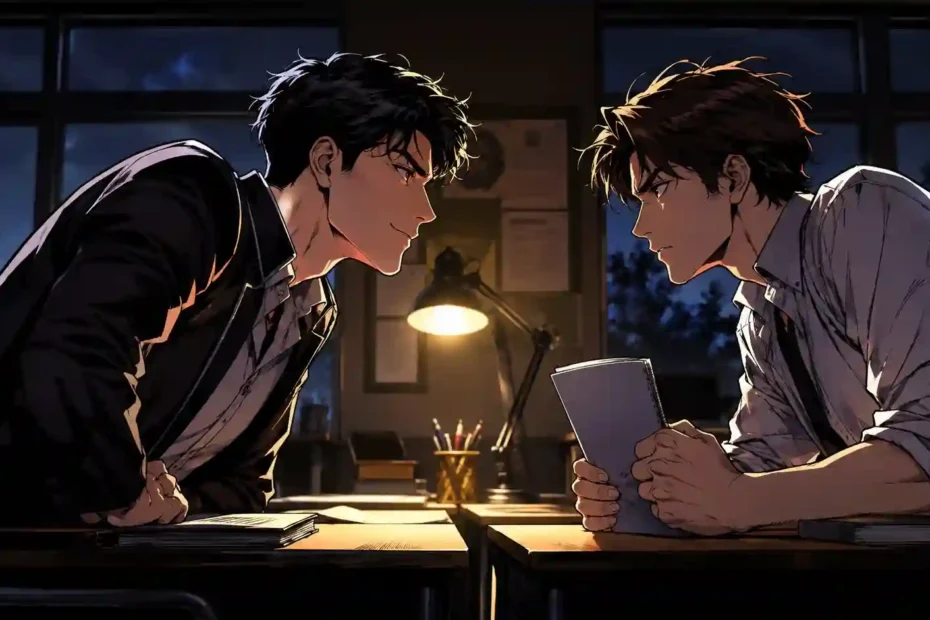
THE HOOK & INTRODUCTION
The scene that broke the fandom isn’t a fight. It’s a choice. A tiny pause in the dialogue that flips the power dynamic and makes you reread the entire conversation like it’s a confession.
That’s the trick teach me first keeps pulling: it makes “small” moments feel dangerous.
This review pins down what works, what drags, and why readers can’t stop arguing about what the characters really meant.
If you’re deciding whether to start it—or you’re already obsessed—this is your spoiler-aware, detail-first breakdown.
QUICK FACTS DATA TABLE
| Series Metric | Details |
|---|---|
| Title | teach me first |
| Author/Artist | [Insert Author/Artist] |
| Type (Manga/Webtoon/Comic) | Comic |
| Publisher/Platform | [Insert Platform/Publisher] |
| Current Status | [Ongoing/Completed] |
| Genres | [Insert Genres] |
| Age Rating | [Insert Age Rating] |
Plot & Character Dynamics: When “Teaching” Turns Into Control
teach me first thrives on tension that doesn’t need explosions. It’s built on who holds the information, who asks the questions, and who stays quiet on purpose.
The early stretch (think the “setup” chapters/issues where the rules get established) does something smart: it makes the premise feel simple, then shows how quickly it can be weaponized. Watch how often characters interrupt each other mid-sentence. Those cuts aren’t random. They’re the story telling you, “Someone is steering this.”
The best scenes tend to be two-person exchanges with a third party watching. That silent witness function matters. It turns ordinary dialogue into a test. And when the series drops a reversal—the student refusing the lesson, or the teacher revealing they’re improvising—you feel it because the groundwork is already there.
What to look for while reading:
- The recurring phrase “teach me first” as a power move, not a request.
- Moments where a character answers a question with a different question.
- The first time a “rule” gets broken and nobody addresses it out loud.
Character motivation, boiled down
One of the strongest choices here is that nobody is fully honest. Not in a cartoon-villain way. In a realistic way: people protect their version of events. That makes even a slow chapter feel like it’s hiding something.
Art Style & Visual Flow: Panels That Feel Like a Trap Closing
The art isn’t just “good.” It’s strategic.
You’ll notice a pattern: wide shots used sparingly, close-ups used aggressively. Faces take over the page when the story wants you cornered. If the series is a comic, pay attention to how the gutters (the space between panels) are handled. Tight gutters speed up the pressure. Bigger gutters create that cold, awkward silence you feel in your stomach.
A standout technique—especially in mid-arc confrontations—is when the layout repeats nearly the same panel composition three times in a row. Same angle. Same framing. Tiny changes in expression. That repetition reads like escalation without the author needing to say, “Things are escalating.”
If you’re here for visuals, this is the selling point: the pacing isn’t only in the dialogue. It’s in the page design.
Color/inking (if applicable)
If your edition uses bold contrast, the series often ties emotional shifts to lighting changes—shadowed eyes, blown-out highlights, backgrounds stripped to near-empty. That isn’t style for style’s sake. It’s the story removing distractions so you can’t look away from what the character is avoiding.
Theories, Turning Points, and What Readers Keep Missing
The community debate usually circles one question: is the central relationship about growth, manipulation, or both?
Here’s what the text supports: the series keeps planting “double-meaning” lines that read romantic in one context and threatening in another. That’s why people fight over the same panels. It’s not because readers are clueless. It’s because the series is feeding two interpretations on purpose.
The biggest turning point (you’ll know it when you hit it) is when a character does something “out of character” and the narration doesn’t correct it. No inner monologue. No apology panel. Just action. That’s the author saying: this is who they are when they stop performing.
If the story is ongoing, expect the next arc to cash in on one of two payoffs:
- The “teacher” figure loses control publicly.
- The “student” figure admits they wanted the lesson for the wrong reason.
Either way, the most important clue is consistency: the series has been telling you who’s in charge via blocking (who stands higher, who steps into whose space, who gets the last panel).
HIGH-VOLUME FAQ SECTION
Where can I read teach me first officially?
The official source depends on the publisher/platform. Check the series page on [Insert Platform/Publisher] first, since official reads support the creators and usually have the cleanest image quality.
When is the next teach me first chapter/issue release date?
Release timing varies by platform and region. If it’s ongoing, the most reliable update is the publisher’s listing page and the creator’s verified social accounts—those usually announce breaks and schedule shifts first.
Is teach me first getting an anime or live-action adaptation?
There’s no safe confirmation unless it’s announced by the publisher, a major trade outlet, or the official series account. If you see “confirmed” with no source link, treat it as rumor until an official press release drops.