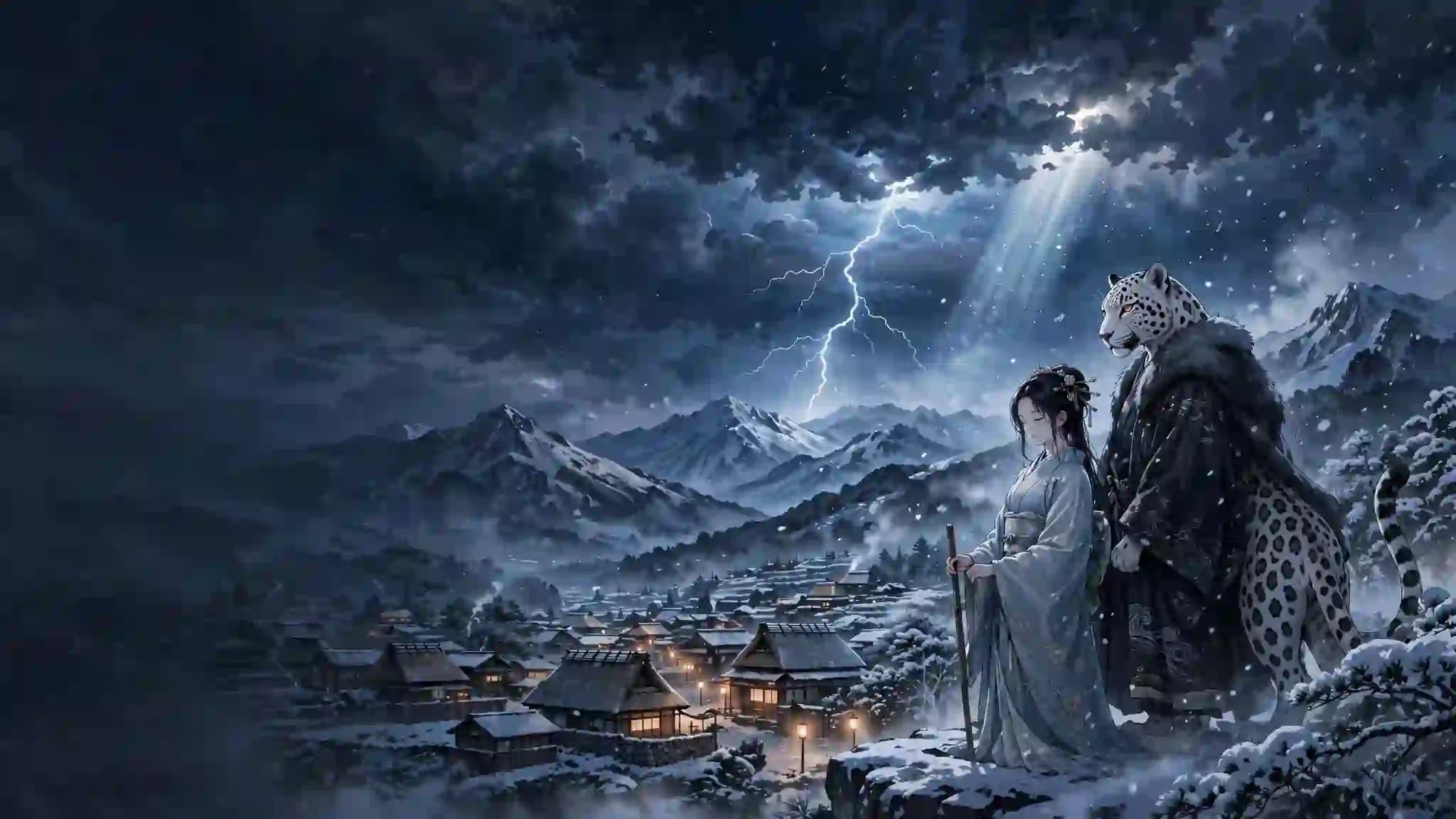
A leopard spirit who hates humans. A blind woman who can push him back. A love that arrives at the worst possible time. Raimei to Zansetsu packs all of that into one carefully built doujinshi, and this guide covers the story, the people in it, the ideas underneath it, and how to read it without going in blind.
Raimei to Zansetsu at a Glance
| Detail | What to know |
|---|---|
| Japanese title | 雷鳴と残雪 |
| English title | Thunder and Snow |
| Creator | JINMEN Shijimi, credited with the circle name NegiManju |
| Original publisher | DLsite, under the Garumani Senbai label |
| Release year | 2023 |
| Format | Doujinshi, oneshot, complete |
| Genres | Adult, historical, romance, supernatural, fantasy, josei |
| Main characters | Shao, a leopard spirit; Yukino, a blind human woman |
| Content notes | Explicit sexual content, mature themes, non-consensual sexual content, blood and gore tags |
| Official translations | English, Simplified Chinese, Korean |
| Best for | Readers who want a short, intense supernatural romance with a bittersweet edge |
| Not for | Readers under 18, or anyone looking for a light and low-stakes love story |
What Is Raimei to Zansetsu?
Raimei to Zansetsu is a Japanese adult doujinshi about a supernatural leopard being named Shao and a blind human woman named Yukino. Shao appears with a thunderclap, raids villages, and hates humans. Yukino repels him with a power he cannot explain, and their repeated clashes slowly turn into something neither of them planned.
The work is a complete oneshot, not a long-running series. That is why it can deliver a full emotional arc in a short read. The English title, Thunder and Snow, comes from the Japanese 雷鳴と残雪.
The phrase pairs a sudden, violent force with a quiet, stubborn one. That contrast is the engine of the story. Shao is the storm that announces itself. Yukino is the snow that stays in the shade after spring has arrived.
Their relationship works because neither of them fits the category the other expects. This guide is designed for those who would like background information before beginning.
It explains the premise, the main characters, the title, the themes, the content warnings, and the legal places to find the work.
It also compares the work with similar supernatural romances so you can decide whether it belongs on your reading list.
Who Created Raimei to Zansetsu?
Japanese artist JINMEN Shijimi created the work, also using the circle name NegiManju. DLsite published it in 2023 under the Garumani Senbai label, a platform known for self-published adult manga.
That route matters. Doujinshi creators keep control of their work, set their own terms, and sell directly to readers. When you buy through the official listing, the money goes to the person who made the story.
The creator is also responsible for the art, which gives the work a consistent visual voice. The story is short, so every page has to carry weight. That constraint shows in the way the plot moves from confrontation to intimacy without long detours.
Official English, Simplified Chinese, and Korean translations exist. That is good news for readers outside Japan, because it means you do not have to rely on unofficial scanlations to understand the story. It also means the creator’s original intent survives in languages other than Japanese.
The Story of Raimei to Zansetsu, Without Major Spoilers
The plot follows a clear seven-stage path. Each stage changes the balance of power between Shao and Yukino, and each one makes the final outcome feel earned rather than sudden.
| Story stage | What happens | Why it matters |
|---|---|---|
| The attacks | Shao appears with thunder and raids human villages | Establishes him as a dangerous outsider |
| The first encounter | Yukino repels him with an unexplained power | Flips the power dynamic in her favor |
| The rematches | Shao challenges her again and again, and keeps losing | Turns hostility into a strange kind of closeness |
| The lost journey | The two end up stranded together | Forces honesty and removes the audience |
| The realization | Shao falls in love with Yukino | The conflict moves from the battlefield to his heart |
| The obstacle | Yukino is already married | Makes the love impossible on paper |
| The resolution | The obstacles clear and the two finally act on their feelings | Delivers the pure-love payoff the story promises |
The early chapters are built on repetition. Shao attacks, Yukino wins, Shao returns. That pattern could feel thin in a longer work, but here it does real work.
Each loss strips away another layer of his pride. By the time the two are lost together, he has already learned that he cannot dominate her. The only thing left is to understand her.
The middle of the story is quieter. The thunder and the raids give way to a journey through unfamiliar terrain, where the two have to rely on each other. This is where the romance becomes believable.
Shao does not fall for a fantasy version of Yukino. He falls for the person who keeps beating him and keeps letting him come back.
The final obstacle is the marriage. It is a simple fact, but it changes the emotional temperature of everything before it. There is more to the love story than just two individuals who are attracted to one another.
It is about two people who want something they are not supposed to have. That tension is what makes the ending land.
Shao: The Leopard Spirit Who Hates Humans
Shao is the kind of character who is easy to describe and hard to reduce. He is a supernatural being with a leopard’s nature, a human’s pride, and a deep distrust of people.
He arrives with thunder, which makes him sound like a natural disaster. The villages he attacks treat him as a monster, and he treats them as prey. The story does not ask you to excuse that behavior.
It asks you to watch what happens when someone refuses to be afraid of him. His animosity toward people is genuine. It influences his speech, his fighting style, and his perception of affection.
When Yukino repels him, he does not see a person with power. He sees a challenge. His repeated attempts to get the better of her are driven by wounded pride as much as by violence.
Every loss tells him something he does not want to hear: that strength alone will not win her. The romance changes him without turning him into a different character.
He stays wild, blunt, and physically imposing. What shifts is his attention. He starts watching Yukino for reasons that have nothing to do with winning.
The story lets that shift happen slowly, through small moments rather than a single dramatic speech. Shao works because he is not a misunderstood hero. He is a being who has to learn that another person’s refusal is not an invitation to try harder.
The story gives him room to grow without pretending his past behavior was acceptable.
Yukino: The Blind Woman with Strange Powers
Yukino is the still point around which the story turns. She is blind, married, and in possession of a power that can push a supernatural being back. The synopsis describes her as a woman with strange powers, and that phrase is accurate.
She is not a passive prize waiting to be won. She is the reason Shao keeps losing. Her blindness is part of her character, not a plot device that makes her helpless.
She moves through a world that is not built for her, and she does it with a composure that unsettles Shao. He cannot rely on the usual intimidation tactics because she does not respond to them the way he expects.
Her difference is the source of her strength. The snow metaphor belongs to her. The official English tagline says, “I thought of her as a woman who was like the snow that sits unmelted in the shade, even though Spring has already arrived.”
That line tells you how Shao sees her: quiet, cold to the touch, and impossible to wish away. It also tells you what he is up against. Snow in the shade does not melt just because the season changes.
Yukino does not change just because Shao wants her to. Her marriage is the story’s hardest fact. It gives the romance a weight that a simple enemies-to-lovers plot would lack.
Yukino is not available, and the story does not pretend otherwise. The emotional question is not whether she can be won. It is what two people owe each other when the feeling is real but the timing is wrong.
Why the Title “Raimei to Zansetsu” Matters
The title is doing more work than most readers expect. 雷鳴 (raimei) means a thunderclap or the sound of thunder. 残雪 (zansetsu) means snow that lingers after the season has turned.
Put together, the phrase describes two kinds of persistence: one loud and sudden, one quiet and slow. The English title, Thunder and Snow, keeps the contrast but loses some of the poetry.
The Japanese title suggests that the snow is a remnant, something left behind after spring has already arrived. That makes Yukino sound like a person who has outlasted a season of her life. It also makes Shao sound like the weather that interrupts her.
| Language | Title | Literal sense |
|---|---|---|
| Japanese | 雷鳴と残雪 | Thunder and lingering snow |
| English | Thunder and Snow | Storm and stillness |
| German | Donner und Schnee | Thunder and snow |
| French | Tonnerre et neige | Thunder and snow |
| Spanish | Tormenta y nieve | Storm and snow |
| Korean | 번개와 눈 | Lightning and snow |
| Chinese | 雷鸣与残雪 | Thunder and lingering snow |
The title also frames the relationship. Thunder does not ask permission. Snow does not move out of the way. One is an event, the other is a condition.
Shao wants to be the event that changes Yukino’s life. Yukino is the condition he cannot change. That is why the title stays with you after the last page.
The Romance at the Center: Why an Unattainable Love Works
The love story in Raimei to Zansetsu is built on obstacles, not misunderstandings. The two characters do not need a contrived secret or a jealous rival to keep them apart. They have species, history, and marriage.
Those are real barriers, and the story treats them with appropriate seriousness. The repeated defeats are the foundation of the romance. Shao cannot force his way into Yukino’s life, so he has to learn how to be near her.
The story uses that constraint to build intimacy. Every failed challenge brings him closer to the person he is trying to beat. By the time he realizes he is in love, the reader has already watched the feeling grow.
The “pure love” label is not ironic. The story is explicit, but its emotional core is sincere. Shao’s love is not a reward for good behavior.
It is a genuine attachment to someone who sees him clearly and does not flinch. Yukino’s feelings are harder to read, and the story respects that ambiguity. She is not a prize that softens at the end.
She is a person with her own history and her own limits. The bittersweet edge is what makes the romance memorable. A story where the couple simply rides off into the sunset would waste the setup.
The story earns its ending by making the couple work for it. The final pages deliver the payoff, but they do not erase the cost.
Themes That Give Raimei to Zansetsu Its Weight
- Otherness. Shao is not human, and the story does not let him forget it. His leopard nature is a source of power and a reason for isolation. The romance asks whether two people from different worlds can build something that lasts.
- Loneliness. Both leads are isolated in different ways. Shao is alone because humans fear him. Yukino is alone because her blindness and her marriage separate her from the people around her. Their connection fills a space that neither of them knew was empty.
- Agency and consent. The story’s central conflict is about a man who wants something a woman has not offered. The repeated losses matter because they force him to stop treating her as a challenge to be conquered. The later intimacy is meaningful because it follows that shift.
- Impermanence. The snow metaphor carries a quiet sadness. Snow in the shade is beautiful because it will not last. The story uses that image to remind the reader that the couple’s happiness is hard-won and fragile.
- Redemption through connection. Shao does not become good because he is told he is bad. He becomes better because he cares about someone who sees him clearly. That is a more convincing arc than a sudden change of heart.
- The danger of idealizing. Shao’s early view of Yukino is a fantasy built on her difference. The story complicates that view by showing her as a person with a marriage and a history. Love becomes real when the fantasy gives way to the person.
These themes are not heavy-handed. They emerge from the plot and the characters, which is why they feel earned. The story trusts the reader to notice them without a lecture.
Art, Mood, and the Historical Setting
The historical setting gives the story a visual and emotional distance. The villages, the travel, and the supernatural threat all belong to a world that is not modern. That distance makes the romance feel like a legend rather than a contemporary drama.
It also gives the creator room to use weather as a storytelling tool. The title’s imagery shapes the mood. Thunder scenes are loud, dark, and sudden. Snow scenes are pale, quiet, and still.
The contrast between them mirrors the relationship. Shao brings the storm. Yukino brings the snow. The story moves between the two, and the reader feels the temperature change.
The doujinshi format works in the story’s favor. A short work cannot afford filler. Every scene has to move the relationship forward or deepen the conflict.
That compression gives the plot a momentum that longer series often lose. It also makes the emotional beats hit harder, because there is no room to pad them.
The art is consistent with the story’s tone. It does not soften the supernatural elements or turn the romance into a generic fantasy. The leopard nature of the lead is part of the visual identity, not a costume.
That commitment to the premise is one reason the work has found an audience.
Content Advisory: Who Should Read Raimei to Zansetsu
This is an adult work. It contains explicit sexual content and is intended for readers 18 and older. The official listing also carries tags for mature themes, non-consensual sexual content, blood, and gore.
Those tags are not decorative. They describe material that some readers will find upsetting. Read the full tag list before you buy.
The story is not a typical romance, and the content is not incidental to the plot. If you are sensitive to non-consensual scenarios or graphic violence, this is not the right read for you.
If you are looking for a gentle, low-stakes romance, look elsewhere. The advisory is not a reason to dismiss the work. It is a justification for taking an honest attitude.
The story’s emotional power comes from the same place as its darkness. Knowing what you are getting into lets you decide whether the payoff is worth the discomfort.
Where to Read Raimei to Zansetsu Legally
The official place to find the work is DLsite, where it was originally published. The listing includes the Japanese version and, according to the series record, official English, Simplified Chinese, and Korean translations.
Availability can vary by region and platform, so check the official listing for the version you need. Buying through the official channel supports the creator directly.
That matters in doujinshi, where a small audience can make the difference between a project that continues and one that does not. It also ensures you are reading the version the creator approved.
Avoid unofficial aggregators and scanlation sites. They often host altered pages, incomplete chapters, or low-quality translations. They also cut the creator out of the revenue.
If a site offers the work for free and does not credit the official publisher, assume it is not authorized. If you cannot access the official version in your region, check whether the platform offers a different regional storefront or a language version you can use.
Do not assume the work is unavailable until you have checked the official listing.
How to Read Raimei to Zansetsu: A Short Reader’s Companion
- Read it in one sitting. The story is short, and its momentum depends on continuity. Splitting it up weakens the effect of the repeated encounters.
- Watch the power balance. Notice who holds the upper hand in each scene. The answer changes as the relationship develops, and that change is the plot.
- Pay attention to the weather. Thunder and snow are not just decoration. They signal the emotional temperature of each scene.
- Do not skip the quiet parts. The journey and the conversations are where the romance becomes believable. The action scenes get the attention, but the quiet scenes do the work.
- Read the official translation. A good translation preserves the tone of the original. An unofficial one may not.
- Keep the content warning in mind. The story is dark in places. Go in with your eyes open, and take a break if you need one.
Raimei to Zansetsu and Similar Works
| Work | Creator | Year | Format | Shared element | What makes it different |
|---|---|---|---|---|---|
| The Ancient Magus’ Bride | Kore Yamazaki | 2013 | Manga | Supernatural romance between a human and a non-human | A short, self-contained oneshot with an adult edge |
| My Happy Marriage | Akumi Agitomi, art by Rito Kohsaka | 2018 | Light novel and manga | Historical Japanese romance with supernatural abilities | A darker, more physical story with a supernatural male lead |
| Beastars | Paru Itagaki | 2016 | Manga | Interspecies attraction and social tension | Focused on one couple rather than a society-wide drama |
The closest comparison is The Ancient Magus’ Bride. Both stories pair a human with a non-human being and use the relationship to explore otherness. The difference is scope.
The Ancient Magus’ Bride builds a world over many volumes. This work tells one story in one sitting.
My Happy Marriage shares the historical Japanese setting and the theme of a woman with unusual abilities. It is gentler and more romantic. The work is more direct about desire and more interested in the cost of wanting someone you cannot have.
Beastars uses interspecies tension as a social metaphor. This work treats it as a personal matter. The story is not interested in building a society; it is interested in what happens when two individuals stop seeing each other as categories.
The Raimei to Zansetsu Topic Cluster: Related Entities to Explore
| Entity type | Related terms | Why it matters |
|---|---|---|
| Work | Thunder and Snow, 雷鳴と残雪 | The central subject and its official titles |
| Creator | JINMEN Shijimi, NegiManju | The artist and circle behind the work |
| Publisher | DLsite, Garumani Senbai | The original platform and label |
| Characters | Shao, Yukino | The two leads and their dynamic |
| Genres | Josei, doujinshi, supernatural romance, historical fantasy | The categories readers use to find the work |
| Themes | Otherness, loneliness, impermanence, forbidden love | The ideas that give the story depth |
| Comparisons | The Ancient Magus’ Bride, My Happy Marriage, Beastars | Related works for readers who want more |
Building a topic cluster around these entities helps readers move from one question to the next. A reader who finishes this guide may want to know more about the creator, the publisher, or similar titles.
Each of those paths is a natural next step, and each one strengthens the topical authority of the page.
Frequently Asked Questions
What is Raimei to Zansetsu about?
It follows Shao, a supernatural leopard being who attacks human villages, and Yukino, a blind woman who repels him with a strange power. Their repeated clashes turn into a romance, but Yukino is already married. The story is a short, adult supernatural romance with a bittersweet edge.
Who is the author of Raimei to Zansetsu?
JINMEN Shijimi created the work, also using the circle name NegiManju. DLsite published it in 2023 under the Garumani Senbai label. The creator handles both the story and the art.
Is it a manga or a light novel?
It is a manga, specifically a doujinshi oneshot. It is a single, complete work rather than an ongoing series. That format is why it can deliver a full arc in a short read.
Does the work have an anime adaptation?
No. There is no anime adaptation of the work. It exists as a self-published doujinshi, and its audience comes from readers who find it through DLsite and word of mouth.
Is it available in English?
Yes. The series record lists an official English translation alongside Simplified Chinese and Korean versions. Availability depends on the platform and your region, so check the official DLsite listing for the current options.
How long does it take to read?
It is a oneshot, so it can be read in one sitting. The exact length depends on the edition and the reader’s pace. The short format is part of its appeal: the story stays focused and does not overstay its welcome.
Should You Read Raimei to Zansetsu?
Read it if you want a short, intense supernatural romance with a clear point of view. The story does not waste time on filler. It builds a conflict, complicates it with real feelings, and pays it off.
The art and the historical setting give it a mood that stays with you after the last page. Skip it if you are looking for a light romance or if the content warnings are a problem for you.
The work is explicit and dark in places, and it does not pretend otherwise. Knowing that before you start is the best way to enjoy what it does well.
If you have read it, the most interesting conversation is about the ending. Does the couple earn their happiness, or does the story simply decide they have suffered enough?
That question is worth discussing. Share your take with other readers, and keep an eye on the creator’s official page for future work.