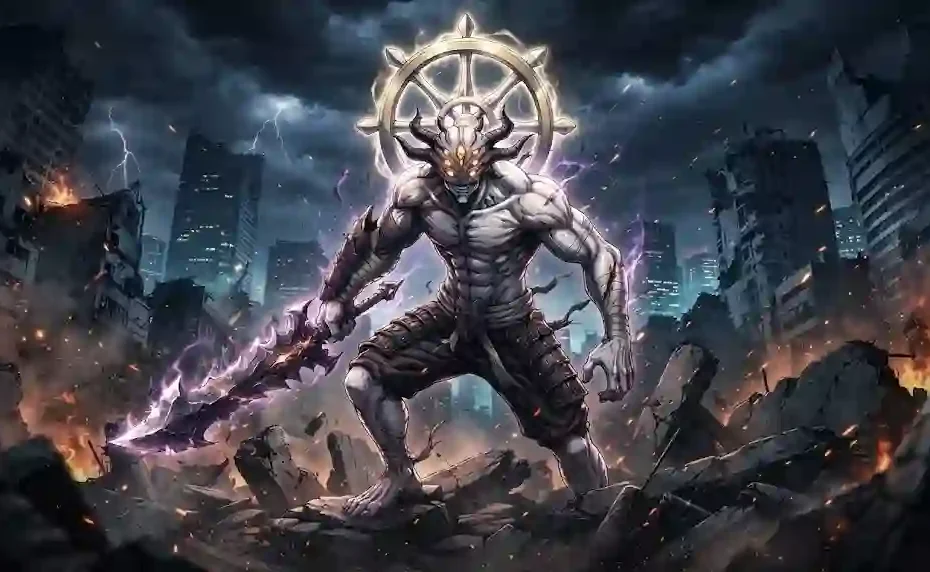
You’ve seen it: the towering shikigami that shrugs off a killing blow, waits for its wheel to turn, and walks away changed. In Shibuya, even the King of Curses had never seen its like. Mahoraga breaks the logic every other cursed technique in Jujutsu Kaisen follows, so half the fan debate online is built on wrong assumptions. This guide pins down the real rules — the chant, the wheel, every fight, and who can stop it.
Who Is Mahoraga in Jujutsu Kaisen?
Mahoraga is the strongest shikigami in the Ten Shadows Technique, the inherited cursed art of Megumi Fushiguro. A shikigami is a spirit construct bound to a user’s shadow, and this one sits at the very top of its army. The series calls it the Divine General, and the title fits: a towering, pale, eight-armed humanoid with four wings out of its eye sockets, a tail curving from the back of its head, and an eight-handled wheel floating above its crown.
The design reads like a deity pulled from a temple painting. It wears black hakama and a white sash, wields a forearm blade called the Sword of Extermination, and hits with enough strength to shatter concrete. Its speed once startled Satoru Gojo, the strongest sorcerer of his era.
Five facts to lock in:
- It is the top entry of the Ten Shadows roster and the only shikigami that refuses to obey.
- No user in the Zenin clan’s history ever tamed it — until the finale changed that.
- Its wheel gives it the ability to adapt to any and all phenomena.
- Its blade runs on positive energy, which makes it a natural hunter of curses.
- Summoning it is a ritual of subjugation, and in Fushiguro’s hands it doubles as a death pact.
It first appears in the Shibuya Incident arc, manga chapter 117, and later in the anime’s second season, where the fight that introduced it became one of the most requested re-releases in the series’ history.
The Full Name and What It Actually Means
The full designation in English is Eight-Handled Sword Divergent Sila Divine General Mahoraga. The original Japanese title reads Yatsuka-no-Tsurugi Ikaishinshō Makora, and every part of it is a working piece of worldbuilding, not decoration.
The name breaks down like this:
- Eight-Handled Sword (Yatsuka-no-Tsurugi): one of the Ten Sacred Treasures from Japanese legend, a sword eight hands long. Every shikigami in the Ten Shadows is built around one of those treasures.
- Divergent Sila: sila is a Buddhist precept, a moral rule. Divergent marks the exception. A divine general that stands outside the ordinary code.
- Divine General: its rank. Not a soldier, not a hound. The commander at the top of the shadow army.
- The name itself: it borrows from the Buddhist figure Makara, one of the Twelve Divine Generals, the yaksha guardian deities who serve the Medicine Buddha. The official English version settled on the form readers already know, and the earliest Crunchyroll subtitles actually spelled it differently before switching to match.
The summoning line sits in the same tradition. Its opening, Furube Yurayura, translates as “With this treasure, I summon…,” and it comes from the ancient furu no koto chant tied to the Ten Sacred Treasures legend. That is a ritual song about spiritual power so old it predates the sorcerer clans.
Akutami builds every shikigami this way: a name from a real legend, a power that mirrors the legend’s logic. That is why the Divine General feels less like a monster and more like a piece of the world’s history standing up to fight.
How the Self-Modifying Wheel Works
The eight-handled wheel floating above its head is the engine of its power. Jujutsu Kaisen calls the ability adaptation, and the shikigami can use it on any phenomenon it gets hit with: cursed techniques, physical attacks, even the manipulation of space itself.
The process runs in four steps:
- It takes the hit. Analysis starts the moment an attack lands, not before.
- The wheel turns. Each spin marks progress, and repeated hits from the same attack speed the process up.
- Adaptation completes. The shikigami becomes immune or physically resistant to that damage — and the wounds from the hits before adaptation heal.
- It keeps learning. Even after completion, it can develop new ways to counter the same phenomenon.
Adaptation comes in three flavors:
- Defensive: resistance, immunity, and self-healing against damage it has already survived.
- Auxiliary: new senses. Once it adapts to Dismantle, for example, it can see invisible slashes coming and move for them.
- Offensive: it rewrites its own attacks. Around the Sword of Extermination it can flip positive energy into cursed energy depending on the target, and in the finale it developed space-cutting slashes that bypass a barrier of infinity.
What it cannot do is adapt to what has never hit it. The wheel needs time, and the only reliable counter is to strike with something new every single time. Sukuna compared the wheel to a “perfect cycle” and linked it to Yamata-no-Orochi, the eight-headed serpent of Japanese myth.
A quick note on “modulo.” Fans searching that term usually mean this modification wheel, or they mean the sequel titled Jujutsu Kaisen Modulo, where the wheel gets its last known battle. Both get covered below.
The Summoning Chant, Word for Word
This is the exact Mahoraga chant, word for word, as the official English version renders it:
“I call forth the Eight-Handled Sword Divergent Sila Divine General Mahoraga with this riches.”
The hand sign is the part people get wrong. Fushiguro does not shape a shadow puppet. He extends both arms forward at a slight upward angle, fists closed, and lets the chant do the work. The opening phrase is the first line of the ancient treasure chant, and the rest of the line recites the shikigami’s full title.
Calling it is nothing like calling Nue or the Great Serpent. The Ten Shadows user can start this ritual at any time, but its purpose is subjugation: the shikigami appears, and the user must defeat it to command it. Nobody in the Zenin clan’s history ever pulled that off. For Fushiguro, the summon doubles as a death pact. The giant kills its summoner first, then turns on the opponent and tries to finish the job.
That is exactly what happened in Shibuya. Wounded by the special-grade cursed user Haruta Shigemo and by Toji Fushiguro, Fushiguro called the giant as a last resort. A single backhand from it brought the already-severely-wounded summoner to the brink of death. The ritual then went on hold in a state of suspended animation, and Sukuna, who had just arrived with his own plans for the boy, had to beat the shikigami himself to keep Megumi alive.
The line also became one of the fandom’s biggest memes. In 2023, “With this treasure, I summon…” filled short-video feeds and timeline threads as the joke answer to any losing situation. Akutami wrote a funeral chant. The internet turned it into a battle cry.
Ten Shadows Technique: How Fushiguro Commands His Army
The Ten Shadows Technique is an inherited family cursed technique. The user stores shikigami inside their own shadow, and the shadow acts as fuel: bigger, purer shadows produce stronger constructs. Fushiguro commands his army one unit at a time, and each shikigami has a job.
The roster:
- Nue: the aerial striker that hurls rocks and dives from above.
- Great Serpent: the massive water beast used for heavy assault.
- Toad: the tank that swallows attacks and debris.
- Fox: the flame manipulator.
- Divine Dogs: twin scouts that work in pairs.
- Kamaitachi: the wind-claw pair that carves through space with razor gusts.
- Merged Beast Agito: the combined form of the four Divine Dogs. Sukuna fields it in the finale.
- Mahoraga: the final entry on the list, and the only one that cannot simply be ordered around.
Commanding the army costs real energy, and the biggest entries carry the biggest price. The Divine General is the extreme case: the only shikigami in the technique that has never been tamed by its owner. A wild card that turns its master’s last stand into either a weapon or a coffin.
One more layer. In the Culling Game, the technique reveals its deepest secret: a final shikigami called Kamui, the last shadow, which Fushiguro alone can call. The wheel belongs to the Divine General, but the technique’s true crown belongs to Kamui.
Sukuna vs Mahoraga: The Fight That Broke the Wheel
Sukuna vs Mahoraga is the fight the fandom measures everything against. Shibuya is falling, Gojo is sealed in a cage of binding vows, and the jujutsu world has no answer for the King of Curses. Fushiguro, at the end of everything, recites the chant.
The exchange plays out in five moves:
- First contact. The Divine General’s positive-energy blade does nothing to Sukuna, and his Cleave rips through it. It survives, and the analysis starts.
- The wheel turns once. The first adaptation lands. Its attacks flip from positive energy to cursed energy, and one blow sends Sukuna crashing through a row of buildings.
- It learns to see. On the next pass, it watches the invisible Cleave slashes arrive and deflects them. Sukuna judges that it has adapted to slashing as a concept, not just to his technique.
- The rules change. Sukuna stops repeating himself. Feints, varied strikes, a different phenomenon with every exchange. The wheel has nothing to lock onto that stays still.
- Malevolent Shrine. The domain opens, and inescapable cleaves come from every angle at a speed the wheel cannot process. The shikigami is cut apart, and Sukuna finishes it with the domain’s divine flame.
Three reasons decided the fight:
- Unpredictability. Adaptation needs repetition; the domain offers none.
- Inescapability. There is no ground to retreat to inside the shrine.
- Speed. The wheel’s rotation time is longer than the domain’s attack cycle.
Sukuna admitted the shikigami was strong, and he revealed something bigger: he had never known it existed before that night. He left Shibuya with a renewed interest in Fushiguro, which set up everything that follows in the story. The anime’s adaptation of the fight was so popular that MAPPA re-released the episode with unreleased footage on Blu-ray and in theaters.
The Gojo Battle: When the Wheel Met Hollow Purple
By the finale’s Shinjuku Showdown arc, the shikigami has a new handler. During the Culling Game, Sukuna claimed Fushiguro’s body through a cursed-object incarnation, and with it the Ten Shadows. He became the first user in the technique’s history to tame the Divine General.
Taming changes how the wheel works. A tamed user can bear the burden of adaptation: the user’s soul wears the wheel, experiences the attacks, and lets the shikigami learn without standing in the line of fire. Sukuna used that mechanic to its maximum.
Against Satoru Gojo, the plan unfolds in stages:
- Five domain clashes. Malevolent Shrine meets Unlimited Void over and over. With Fushiguro’s soul bearing the burden, the wheel completes its adaptation to the domain by the fifth clash and pulls Sukuna free.
- The Infinity. Next target: Limitless. Sukuna wears the wheel himself in hand-to-hand combat. Every time he activates domain amplification, the wheel blackens and pauses. Five full turns are required.
- The fifth turn. The shikigami summons itself automatically, even as Sukuna lies unconscious. It has already adapted to Infinity and to Cursed Technique Lapse: Blue.
- The counter. It rewrites the nature of its own cursed energy so Infinity stops working on contact, drags Gojo into the shadow, and slashes his shoulder with the Sword of Extermination. A later space-cutting slash severs his right arm. Sukuna fields the Merged Beast Agito to attack three-on-one.
- Gojo’s answer. He regrows the arm, lands a Black Flash, then lures a second one and sends the giant crashing through a wall. When Sukuna launches it to intercept a charging Hollow Purple, Gojo pulls it off course with Blue’s gravity. The shikigami’s indiscriminate adaptation backfires, because it cannot exploit the pull the way Gojo can. A single uppercut knocks it away.
- Erasure. Gojo releases Hollow Purple. The shikigami and its wheel are completely obliterated. The fight’s conclusion plays off-screen, and chapter 236 shows only the aftermath: a severed torso, and a world one strongest sorcerer down.
This battle answered the question the Shibuya fight raised. Adaptation can dismantle an “unbreakable” defense, and erasure is the one phenomenon it can never finish analyzing. Hollow Purple does not damage. It deletes. There is nothing left to adapt to.
Can Any Jujutsu User Defeat It?
Canon says yes, three times. Two of those victories are total. The third ends in a draw that reshaped the story.
| Combatant | Winning move | Where it happened | Canon status |
|---|---|---|---|
| Ryomen Sukuna | Inescapable cleaves inside Malevolent Shrine, finished with the domain’s divine flame | Shibuya Incident (manga chapter 117) | Canon. He later tamed it — first user ever |
| Satoru Gojo | Black Flash openings, then erasure with Hollow Purple | Shinjuku Showdown (finale) | Canon. The shikigami and its wheel, fully destroyed |
| Dabura Karaba | Sub-light-speed strikes, self-healing, and a domain that captured it | Jujutsu Kaisen Modulo (2087) | Canon. Interrupted — the duel ended in a draw |
| Toji Fushiguro | No cursed energy to read; a killing blow before the wheel turns | Never fought in canon | Fan logic |
| Yuta Okkotsu | A copied Hollow Purple and domain-scale speed | Never fought in canon | Fan logic |
The pattern behind every canonical win:
- Erasure, not damage. Purple deletes matter, and adaptation has nothing to process.
- Inescapable randomness. A domain that never repeats gives the wheel nothing to lock onto.
- Raw speed beyond the rotation. Dabura’s sub-light strikes landed before the wheel could finish its cycle.
- The one-hit kill. Any weapon that can destroy it before the first adaptation is a counter.
What does not work: repeating a technique, trading blows, or betting on bigger muscles. The shikigami was built to turn a losing fight into a waiting game — and then win it.
Mahoraga vs Dabura: The 2087 Duel That Almost Ended the World
The original manga ended in September 2024. Its sequel, Jujutsu Kaisen Modulo, written by Gege Akutami and illustrated by Yuji Iwasaki, ran in Weekly Shonen Jump from September 2025 to March 2026: 25 chapters and three volumes. It jumps the clock to January 2087, and the Divine General is back.
A civilization called the Simurians issues a formal one-on-one challenge, a deskunte-style duel in the old jujutsu tradition of settling matters with a single fight. Their champion is Dabura Karaba, a warrior who has never felt pain. The price of Japan’s defeat: the annexation of Tokyo.
Earth’s representative is Yuka Okkotsu. She carries Zenin blood and inherited the Ten Shadows Technique, but the Gojo clan, her family, forbids her from using it. She is allowed only a partial application that borrows shikigami abilities without summoning them. She is also dying: a brain tumor has left her severely weakened.
Her plan is a coin flip with her own life:
- On the day of the duel, January 14, 2087, Yuka steps off her plane over Tokyo.
- Moments before impact, she chants the summoning line and pulls Dabura into the exorcism ritual’s range.
- She dives into the shikigami’s shadow before it can crush her. Her fate is now bound to the fight: the ritual ends only when Dabura dies or the giant is destroyed.
- Dabura answers with a relentless barrage of light beams. The shikigami is impaled from all sides and survives, which triggers its first-ever adaptation to a technique from beyond Earth.
The wheel turns, it regenerates, and the cycle repeats until the adaptation to Light completes. Dabura’s cursed technique stops working, and the giant beats him into feeling pain and fear for the first time in his life. A memory of his past as a warrior comes back. He breaks the Sword of Extermination with his bare hand and decides to end this with pure physical power.
Then the fight breaks its own rules. Moving at sub-light speed, Dabura shatters its left hand before the wheel can react. A sub-light kick detonates into an explosion that levels city blocks and reduces the giant to a fragment — until another rapid spin of the wheel reassembles it. Dabura even figures out reverse cursed technique mid-fight and heals his own leg, something the shikigami has never seen.
At the climax, Dabura prepares his domain. The wheel spins wildly, and he suspects it is trying to adapt to the phenomenon that is his very existence. He captures it inside Otherworld Between Darkness and Light: Reverse Transcendence. Then the Simurians intervene. Marulu Val Vol Yelvori sends Dabura and his sister Spejo back to Simuria, and the duel ends without a winner.
With Dabura out of range, the ritual nullifies. The shikigami vanishes, its wheel dissolving into the shadow beside Yuka, who is released from suspended death. The final chapter closes on a cliffhanger that points to an epilogue, and Gege has confirmed a new series is coming after Modulo.
Fan Theories and Fandom Culture: Female Mahoraga, Figures, and Wallpaper
Start with the design question the fandom asks most. There is no canon version of a female design. The manga and the anime never introduce one, and the shikigami has no gender to begin with — it is a divine construct, not a person. Every such image online is fan art or fanon, and the fandom loves them because the design translates beautifully: same wheel, same wings, new silhouette.
The figure market runs hot, with official statue lines and third-party models chasing the same selling points: the eight arms, the floating wheel, the forearm blade. A buyer’s checklist:
- Wheel support: the floating wheel needs a stand or a clear effect piece. No support means it topples.
- Arm articulation: action lines want at least a few working joints; statues trade that away for paint detail.
- Scale: 1/7 and 1/8 figures give display flexibility; larger statues give shelf presence.
- Energy effects: the glow around the Sword of Extermination is the detail that sells the whole design.
For wallpaper, the cleanest path is official art from the licensed channels linked under Sources, not fan renders. Pick a 4K source for desktops and 1080p for phones, and keep the credit where it belongs: Gege Akutami and MAPPA. Personal use is fine. Reposting official art as your own is not.
The rest of the culture runs on two engines. The summoning chant meme now means any all-or-nothing play, and the power-scaling debates keep the shikigami in the top tier of nearly every list. This guide exists to be the reference when those debates get messy, because every claim above traces back to a chapter or an arc.
Quick Reference: The Divine General at a Glance
| Attribute | Detail |
|---|---|
| Full designation | Eight-Handled Sword Divergent Sila Divine General Mahoraga |
| Japanese title | 八握剣異戒神将魔虚羅 (Yatsuka-no-Tsurugi Ikaishinshō Makora) |
| Master | Megumi Fushiguro, via the Ten Shadows Technique |
| Classification | Strongest shikigami of the Ten Shadows |
| Appearance | Towering pale humanoid, eight arms, wings from the eye sockets, tail from the back of the head, eight-handled wheel above the crown, forearm blade |
| Signature ability | Adaptation to any and all phenomena, driven by the wheel |
| Weapon | Sword of Extermination, a positive-energy blade |
| Weaknesses | A hit before the wheel completes a turn; erasure-type attacks; inescapable, unpredictable barrages |
| First appearance | Manga chapter 117 (Shibuya Incident arc); anime season 2 |
| Canonical defeats | Sukuna (Shibuya), Satoru Gojo (finale), Dabura Karaba (2087, interrupted) |
| Tamed by | Ryomen Sukuna — the first user in the technique’s history |
| Status (September 2026) | Vanished after the 2087 ritual nullified; wheel dissolved into Yuka Okkotsu’s shadow |
This page is the hub of the site’s Jujutsu Kaisen cluster. Each satellite guide below goes deeper into one corner of the same story:
- The Ten Shadows Technique, fully explained: /ten-shadows-technique-guide
- Sukuna’s Shibuya timeline, chapter by chapter: /sukuna-shibuya-timeline
- Jujutsu Kaisen Modulo: the 2087 sequel explained: /jujutsu-kaisen-modulo-guide
- Gojo vs Sukuna: how the final fight played out: /gojo-vs-sukuna-explained
- Dabura Karaba: the Simurian champion, character guide: /dabura-karaba-character-guide
Frequently Asked Questions
What is Mahoraga’s full name in Jujutsu Kaisen?
Its full designation pairs the title Eight-Handled Sword Divergent Sila Divine General with the name you are already searching for. In the original Japanese, the title ends in the kanji for “demon-void,” read Makora, and the official English version settled on the familiar form.
What does Megumi say to summon the Divine General?
He chants, “With this treasure, I summon…,” then recites the full title, with both arms extended forward and fists closed. There is no shadow-puppet hand sign. The line itself is the trigger.
How does Mahoraga’s wheel work?
Every hit it survives starts the wheel turning. When the rotation completes, it becomes immune to that exact damage and heals the wounds the hit caused. The same attack can never kill it twice.
Who can defeat Mahoraga?
Canon answers fully: Sukuna cut it down in Shibuya, Gojo erased it with Hollow Purple in the finale, and Dabura Karaba trapped it in his domain in 2087. Toji and Yuta remain the top untested matchups on fan logic.
Is there a female Mahoraga?
No. The manga and the anime never introduce one, and the shikigami has no gender to begin with. Every such image you have seen is fan art, not canon.
Where does the name come from?
From the Buddhist guardian figures the design borrows from: yaksha generals who serve the Medicine Buddha, and a half-serpentine race of Dharma protectors. The name, the chant, and the wheel all draw on the same ancient traditions.
The Wheel Is Turning. Now Take a Stand
From a backhand in Shibuya to a duel with an alien in 2087, the shikigami’s story is the story of the whole series: power that adapts, users who pay for it, and the one counter that always wins — something it has never seen before.
- Tell us your verdict in the comments: in an untested matchup, who wins, Toji or Yuta?
- Save the quick reference table for your next power-scaling argument.
- Read the finale in English (Volume 30, out May 2026), or catch up on Modulo’s chapters free on Manga Plus.
- Follow the cluster links above to go deeper. Each guide is a full satellite of this page.
The wheel only turns when it gets hit. Bring your take to the fight.