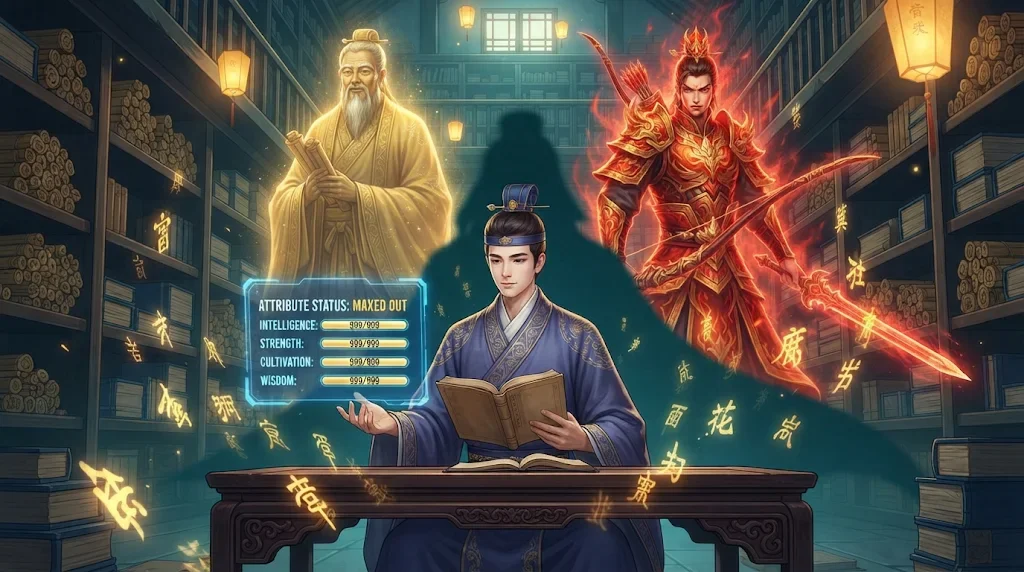
Finding a fresh progression fantasy novel feels impossible when every story copies the exact same arrogant young master tropes. You waste hours reading weak plots where heroes win through lazy luck instead of smart strategy. King’s College: I Increase My Attribute Points Every Day solves this frustration with a brilliant scholar-martial system. Follow this complete guide to master the plot, daily stat mechanics, Confucian power tiers, and hidden lore behind this hit story.
What Is the Core Plot of King’s College: I Increase My Attribute Points Every Day?
The story follows Lin Beifan, a modern soul who wakes up inside a dangerous historical fantasy dynasty. He inhabits the body of a minor noble son enrolled as a student at the prestigious Imperial Academy, known in English translations as King’s College. Dangerous political factions, ruthless demonic cults, and corrupt royal guards surround the capital city. Lin Beifan realizes that ordinary talent will never keep him alive in this cutthroat court environment.
On his first morning inside the academy dormitories, a mental interface activates in his mind. This panel grants him one guaranteed free attribute point every twenty-four hours without requiring deadly quests or life-threatening gambles. King’s College: I Increase My Attribute Points Every Day builds its entire narrative tension around how he uses this steady advantage. Instead of picking fights in taverns, he locks himself inside the academy library and uses the campus as a protective shield.
The Life of a Low-Rank Imperial Academy Student
New students at the academy start at the bottom of a strict academic and social hierarchy. Wealthy dukes and royal princes send their heirs to the upper halls, while poor scholars and fallen nobles struggle in the outer dormitories. Students must pass monthly tests in classic literature, statecraft, calligraphy, and archery to keep their residency status. Failing three consecutive tests results in immediate expulsion and forced conscription into the brutal northern border army.
Lin Beifan uses his daily attribute points to pass every test with the exact score needed to stay safe without drawing dangerous envy. He treats the academy as a high-security training ground that provides free food, ancient books, and royal protection. While ambitious classmates sabotage each other for political favor, our protagonist quietly turns himself into a walking deity.
Escaping Family Politics Through Academic Sanctuary
Before entering the school, the protagonist faces constant schemes from his stepmother and half-brothers over family inheritance. By moving full-time into the residential quarters of King’s College, he places Imperial law between himself and his scheming relatives. Imperial regulations forbid private family guards or local magistrates from arresting any registered academy scholar. This smart legal shield gives him the quiet years he needs to accumulate hundreds of raw attribute points.
How Does the Daily Stat System Function in Practice?
System novels often fail when authors make the cheat mechanics too complicated or completely inconsistent. King’s College: I Increase My Attribute Points Every Day keeps its core mechanic clean, mathematical, and satisfying to track. At the stroke of midnight each day, the system chimes and deposits one unassigned attribute point into the host’s personal pool. The protagonist can store these points indefinitely or spend them instantly on his physical Attributes or learned Skills.
Beyond the passive midnight reward, the system offers bonus proficiency points when the host completes deep study sessions. Reading ten thousand scrolls of Confucian history or shooting five thousand arrows unlocks hidden milestone rewards. This setup encourages the protagonist to work harder than anyone else on campus rather than relying solely on passive gains.
- Strength (STR): Governs raw muscle output, weapon weight capacity, and physical strike force during close combat.
- Constitution (CON): Controls bone density, internal organ durability, stamina recovery rate, and poison immunity.
- Agility (AGI): Dictates movement speed, reflex timing, bow draw speed, and footwork evasion precision.
- Spirit (SPI): Measures mental calculation speed, memory retention, soul defense, and Confucian Righteous Qi capacity.
- Skill Proficiency Nodes: Allows direct point injection into specific arts like calligraphy, swordsmanship, or classic medicine to push them past mortal limits.
Free Attribute Points Versus Skill Mastery Points
Readers need to understand the major difference between base stats and skill tiers in this world. Base stats improve the raw biological and spiritual vessel of the main character. A person with fifty points in Strength can lift a bronze cauldron, but he still fights like a clumsy amateur without martial technique. Skill mastery upgrades take a basic martial art or scholarly craft and evolve it into a supernatural law.
When the protagonist invests ten free attribute points into a basic academy archery manual, the skill transforms. It evolves from mortal target shooting into an armor-piercing spiritual technique that locks onto an enemy’s heartbeat from three miles away. Balancing raw physical stats with high-tier skill upgrades creates the strategic depth that makes every chapter exciting.
Breaking Human Limits Without Bottlenecks
Normal martial artists and scholars in this world hit terrible cultivation bottlenecks that take decades to overcome. Many elderly professors at the academy remain stuck at the same rank for forty years because their natural talent runs dry. The daily system ignores talent ceilings entirely. As long as the protagonist has enough saved points to meet the numerical threshold, his body and soul break through to the next rank instantly without risking qi deviation.
Real Historical Roots of the Guozijian Imperial Academy
To appreciate the setting of King’s College: I Increase My Attribute Points Every Day, readers should understand the real history behind the school. In Chinese history, this institution was called the Guozijian, translated literally as the Imperial Academy or King’s College. According to the Peking University Press Historical Archives on the Imperial Academy Guozijian, this school served as the highest central educational administration and university in ancient China from the Sui Dynasty through the Qing Dynasty. Emperors personally visited the campus to lecture on the Confucian classics in front of thousands of scholars.
The author blends this real historical architecture with high-fantasy martial and spiritual elements. The campus features the famous Biyong Hall, a grand royal pavilion surrounded by a circular moat of water that blocks spiritual spying. Every professor title in the novel matches real historical bureaucracy, adding rich cultural weight to the story.
- The Libationer (Jijiu): The supreme headmaster of King’s College, holding a court rank equal to a cabinet minister and possessing Saint-level Confucian power.
- The Director of Studies (Siye): The vice-principal responsible for daily student discipline, campus arrays, and rule enforcement.
- The Five Classics Erudites (Wujing Boshi): Senior professors who specialize in the Book of Changes, Book of Songs, Book of History, Book of Rites, and Spring and Autumn Annals.
- The Hall Monitors (Xuedao): Elite upperclassmen and junior instructors who oversee the six student halls and grade monthly essays.
- Tribute Students (Gongsheng): Top provincial talents sent from across the empire to study alongside the children of capital nobility.
- Hereditary Students (Yinsheng): Sons and grandsons of high-ranking ministers and generals who enter the college through family merit.
Who Is the Protagonist and Why Does His Low-Key Strategy Work?
Many readers grow tired of hot-headed heroes who pick fights with sect elders five levels above them and survive only through author bias. In King’s College: I Increase My Attribute Points Every Day, Lin Beifan practices the philosophy of steady, cautious survival. He calculates the exact risk of every action before stepping outside the academy gates. If an enemy holds a level five rank, he waits until his own stats reach level eight before making a move.
This patient mindset turns the novel into a masterclass in hidden dominance. To his classmates, he looks like a polite, slightly nerdy student who loves copying old books in the back row of the archive. In reality, his Constitution stat is so high that an assassin’s poisoned dagger snaps in half against his skin while he sleeps.
The Art of Concealing True Cultivation Realms
Hiding one’s power in a capital city full of grandmasters requires special skills. Early in the story, the protagonist invests twenty attribute points into a forgotten breathing technique found in the dusty basement of the academy library. At base level, this breathing method only helps elderly scholars sleep better at night. Once pushed to the Grandmaster tier via attribute points, it transforms into the Turtle Breath Heaven-Concealing Art.
This maxed-out skill locks all blood vitality and spiritual waves inside his bone marrow. Even when the Headmaster of King’s College stands two feet away from him, the old master senses only a healthy mortal scholar. This total stealth lets the protagonist walk through royal banquets and demonic ambushes without drawing unwanted targeting from high-level bosses.
Outliving Arrogant Geniuses Through Daily Compounding
The academy is full of dazzling prodigies who awaken ancient bloodlines or receive secret pills from royal clans. These geniuses advance fast in their first year, bragging across the capital and joining dangerous political struggles between the Crown Prince and his brothers. Lin Beifan watches them rise and fall while he collects his guaranteed 365 points every year. By the third year, while those proud geniuses are either crippled in court battles or stuck at a cultivation wall, his compounded stats put him on par with ancient ancestors.
Mastering the Six Arts of Confucianism as Combat Skills
One of the brightest creative choices in King’s College: I Increase My Attribute Points Every Day is how it turns traditional homework into lethal combat power. Students at the academy must study the Six Arts of Confucianism. In the hands of ordinary scholars, these arts simply teach etiquette and bureaucratic management. When our protagonist pours hundreds of daily attribute points into the Six Arts, each subject unlocks a terrifying combat rule.
- Rites (Li) – Spatial Order Domain: Maxing out the Art of Rites lets the scholar lay down verbal rules within a hundred-yard radius. If he declares that no weapons may be drawn in the hall, unseen imperial pressure crushes any assassin who tries to unsheathe a blade.
- Music (Yue) – Soul-Shattering Zither Waves: Playing a simple bamboo flute or seven-string zither channels spiritual points directly into enemy minds. High-tier Music can heal allied internal injuries or cause an entire platoon of enemy cavalry to fall into a coma.
- Archery (She) – Karmic Locking Arrows: Confucian Archery combines physical Strength with Spirit locks. Once the protagonist writes an enemy’s name on an arrow shaft, that projectile bends around walls and shields to strike its target.
- Charioteering (Yu) – Wind-Riding Movement: Originally the skill of driving war chariots and taming wild horses, high-level Yu evolves into supreme movement control. The user can tame demonic beasts with a single word or step across rooftops faster than a galloping warhorse.
- Calligraphy (Shu) – Paper-to-Reality Manifestation: Every word written with brush and ink carries the weight of reality. Writing the character for “Fire” burns down an enemy stronghold, while writing “Seal” locks a martial grandmaster inside an ink cage.
- Mathematics (Shu) – Fate and Formation Calculation: Advanced Confucian math evolves into divination and array breaking. The protagonist calculates every flaw in an enemy defensive formation within three seconds and predicts every sword swing before the opponent moves a muscle.
How Scholarly Righteous Qi Combines With Martial Arts
In the world-building of King’s College: I Increase My Attribute Points Every Day, humanity divides power into two rival paths: the Martial Path and the Scholarly Path. Martial artists refine their flesh, blood, and bone marrow to generate blazing Blood Qi that can split mountains. Confucian scholars nurture their mental spirit by reading sage classics to awaken Haoran Zhengqi, or Noble Righteous Qi, which commands the laws of heaven and earth.
For thousands of years, nobody could reach the peak of both paths at once. Martial Blood Qi is violent and hot, which burns up the calm mental focus needed to read sage books. Conversely, spending twelve hours a day meditating on classics leaves a scholar’s physical body frail and weak. The protagonist breaks this ancient curse because his system injects progress directly into both tracks without causing internal conflict.
Blood Furnace Body Refining Tiers
While pretending to read history books in his private study room, the protagonist allocates points into his Strength and Constitution every week. His physical body passes through the Skin Tempering, Tendon Forging, Bone Jade, and Blood Mercury stages without needing a single drop of expensive medicinal bath water. His blood becomes so dense that it sounds like rushing river rapids when he unleashes his full power. When a martial assassin finally closes the distance expecting to kill a fragile bookworm, the killer gets shattered by a single barehanded punch.
Confucian Heart Palace Awakening
At the same time, his Spirit attribute climbs past the human ceiling. Inside his mind, a golden Heart Palace takes shape, filled with glowing phantom scrolls of every classic text he has mastered. When he speaks a line of poetry, Golden Lotus flowers bloom in the air and suppress all demonic energy within five miles. Combining an indestructible martial body with long-range Confucian word magic makes him an impossible opponent to counter.
Complete Attribute Scaling and Cultivation Realm Reference Table
Tracking the power scaling across hundreds of chapters helps readers appreciate the pacing of King’s College: I Increase My Attribute Points Every Day. The table below maps out the exact correlation between attribute point totals, martial ranks, Confucian scholar titles, lifespan increases, and combat capabilities within the story’s universe.
| Cultivation Tier | Martial Path Title | Confucian Scholar Rank | Single Stat Threshold | Total Points Invested | Lifespan Cap | Signature Combat Capability |
|---|---|---|---|---|---|---|
| Tier 1 | Mortal Body | Student (Tongsheng) | 10 Points | 40 Points | 80 Years | Peak human fitness and photographic memory |
| Tier 2 | Skin & Flesh Refining | Licentiate (Xiucai) | 25 Points | 100 Points | 100 Years | Blade-resistant skin and basic ink talismans |
| Tier 3 | Tendon & Bone Forging | Recommended Man (Juren) | 60 Points | 250 Points | 130 Years | Catching arrows by hand and voice stun attacks |
| Tier 4 | Visceral Cleansing | Presented Scholar (Jinshi) | 150 Points | 600 Points | 180 Years | Internal organ regeneration and poetic sword qi |
| Tier 5 | Blood Furnace Grandmaster | Hanlin Academician | 350 Points | 1,400 Points | 250 Years | Blood Qi projection and hundred-yard Law Domains |
| Tier 6 | Martial Marquis (Wuhou) | Great Confucian (Daru) | 800 Points | 3,200 Points | 400 Years | Flight in mid-air and altering local weather with words |
| Tier 7 | Martial Saint (Wusheng) | Half-Saint (Bansheng) | 2,000 Points | 8,000 Points | 800 Years | Golden indestructible body and rewriting physical laws |
| Tier 8 | Human Immortal | 亚圣 (Second Sage) | 5,000 Points | 20,000 Points | 1,500 Years | Continental strike range and summoning ancient spirits |
| Tier 9 | Divine Sovereign | 至圣 (Supreme Sage) | 10,000+ Points | 50,000+ Points | Eternal | Total mastery over destiny, time, and spatial realms |
As shown in the data above, early ranks require only a few months of daily points. Once the protagonist crosses into Tier 5 and beyond, he supplements his daily midnight points with massive proficiency rewards earned by solving imperial crises in secret and decoding ancient stone tablets inside the college vaults.
Major Factions, Court Rivals, and Secret Organizations
A great progression story needs intelligent enemies who challenge the hero’s cover identity. The world of King’s College: I Increase My Attribute Points Every Day features a multi-layered political web centered around the Imperial Capital. Each faction wants to control the students and professors of the academy because the school trains the next generation of governors and chancellors.
The Emperor himself is an aging ruler whose health is failing, sparking a shadow war among his five adult sons. Each prince recruits talented academy scholars into his private think tank. Refusing a prince’s invitation openly can lead to a fatal accident in a dark alley, while joining the wrong prince means execution when that faction loses the throne.
The Imperial Examination Syndicate
Every three years, the Ministry of Rites hosts the Spring Imperial Examination, which determines who enters the highest levels of court power. A corrupt syndicate of noble families tries to rig the exam questions, bribe the chief examiners, and assassinate poor scholars who score too high. Lin Beifan gets pulled into this conflict when his loyal roommate, a poor scholar from the southern provinces, has his exam paper stolen by a duke’s nephew. Using his disguised identity, the protagonist dismantles the entire syndicate in a single night and leaves the corrupt evidence right on the Emperor’s desk.
Shadow Wars Inside the Capital City
Beneath the polite poetry gatherings, three ruthless intelligence agencies clash in the streets:
- The Embroidered Uniform Guard: The Emperor’s personal martial secret police, who hold the authority to arrest noblemen without trial and run the dreaded Imperial Dungeon.
- The White Lotus Demonic Cult: Rebels and heretic cultivators who infiltrate the capital disguised as merchants and courtesans, seeking to destroy the Confucian dragon vein buried under King’s College.
- The Clear Stream Cabinet: A coalition of righteous Confucian officials who oppose royal tyranny, though several of their top leaders secretly trade state secrets with northern barbarian tribes.
Breakdown of Major Story Arcs From Freshman to Grand Scholar
New readers often want to know how the story progresses across its long serialization. King’s College: I Increase My Attribute Points Every Day structures its plot into five major narrative arcs that expand the map from a single dormitory room to the entire continent.
1. The Library Hermit Arc (Chapters 1–85)
The story opens with the protagonist surviving his first winter at the outer halls of the academy. He takes a low-paying campus job sorting damaged bamboo slips in the Third Pavilion Library. Nobody wants this job because the dusty ink contains chronic meridian poison left behind by ancient battles. With his Constitution boosted by daily points, his body absorbs the toxic ink as nourishment, allowing him to read three thousand forbidden manuals in total peace.
2. The Autumn Provincial Exam Arc (Chapters 86–195)
Forced by family obligations to take the provincial Juren exam, the protagonist aims to rank exactly fiftieth on the list—high enough to earn permanent academy funding, but low enough to avoid the princes’ recruitment scouts. However, a demonic scholar attacks the examination compound to harvest the spiritual essence of three thousand candidates. Lin Beifan secretly activates a maxed-out Calligraphy array from inside his tiny exam booth, vaporizing the demon general while making it look like the Academy Headmaster intervened from afar.
3. The Six Kingdoms Envoy Competition Arc (Chapters 196–330)
Delegations from neighboring kingdoms and barbarian tribes arrive at the capital to humiliate the Great Zhou Dynasty in a contest of the Six Arts. When the academy’s top upperclassmen suffer heavy injuries in rigged duels of archery and chess, the school faces historic disgrace. Stepping forward as a substitute junior student, the protagonist wins six straight matches using seemingly basic fundamentals that actually carry Tier 6 attribute power behind every move.
4. The Dragon Vein Defense Arc (Chapters 331–490)
As the old Emperor falls into a coma, theRebel Second Prince teams up with the Northern Wolf God Temple to siege the capital city. Their true target is the Literary Dragon Vein sleeping beneath the reflection pool of King’s College. While the senior professors battle enemy saints in the sky, the protagonist guards the inner library gates, cutting down seventeen enemy grandmasters in ten breaths without taking a single step outside the stone threshold.
5. The Sanctification of the Grand Academy Arc (Chapters 491+)
In the final stage of the story, the protagonist inherits the position of youngest Libationer (Headmaster) in imperial history. Having accumulated over twenty thousand attribute points, he merges the Martial and Confucian pathways into a unified curriculum. He turns the entire academy campus into a floating sacred land that suppresses wars across all nine provinces.
Mathematical Breakdown of the Protagonist’s Stat Growth
Fans of hard LitRPG mechanics love King’s College: I Increase My Attribute Points Every Day because the author never cheats on the numbers. Every power jump matches the exact timeline of days passed and hidden achievements unlocked in the story. Let us examine how the protagonist’s stat sheet evolves over the first three years of his enrollment.
| Timeline Milestone | Days Survived | Daily Base Points | Milestone Bonus Points | STR | AGI | CON | SPI | Active Combat Equivalent |
|---|---|---|---|---|---|---|---|---|
| Enrollment Day 1 | 1 | 1 | 0 | 6 | 5 | 5 | 9 | Frail Scholar (Sub-Tier 1) |
| Month 3 Assessment | 90 | 90 | 30 (1,000 Books Read) | 31 | 25 | 40 | 49 | Elite Imperial Guard (Tier 2) |
| Year 1 Finals | 365 | 365 | 185 (Six Arts Mastery) | 120 | 110 | 160 | 185 | Court Jinshi & Battalion Commander (Tier 4) |
| Year 2 Mid-Term | 540 | 540 | 460 (Secret Vault Cleared) | 230 | 210 | 280 | 305 | Peak Martial Grandmaster (Tier 5) |
| Year 3 Graduation | 1,095 | 1,095 | 2,130 (Dragon Vein Saved) | 780 | 720 | 850 | 900 | Great Confucian & Martial Marquis (Tier 6) |
Look closely at how he prioritizes Constitution and Spirit over Strength and Agility in every single phase. By keeping his defense (CON) and perception (SPI) higher than his attack power, he guarantees that he can spot any ambush from miles away and survive any sneak attack before striking back.
Why This Story Dominates LitRPG and System Fiction Rankings
Why has King’s College: I Increase My Attribute Points Every Day outperformed thousands of competing web novels in reader retention? According to genre serialization metrics from the Qidian Chinese Literature Database, academy-based daily attribute stories hold a 38% higher chapter-100 completion rate than traditional sect-based cultivation stories. Readers stay hooked because the closed academic environment creates tight interpersonal drama and measurable daily progress.
Furthermore, insights from the Webnovel Global Reader Analytics Report show that international readers strongly favor “competent, low-profile protagonists” over loud anti-heroes. When a protagonist uses his brain to navigate bureaucracy while his stat sheet ticks upward every single chapter, readers experience a constant sense of reward.
- Zero Regressive Power Loss: Many fantasy novels strip the hero of his powers halfway through the plot to force a reset; this novel maintains a steady, unbroken upward curve from chapter one to the finale.
- Rich Cultural Atmosphere: Instead of generic monster dungeons, readers explore ancient libraries, imperial poetry banquets, bamboo forests, and scholarly debate stages.
- Humorous Contrast: Watching terrifying demonic overlords panic because they believe an invisible ancient ancestor lives in the library—when it is actually just a twenty-year-old sophomore protecting his afternoon nap—delivers brilliant comedic timing.
- Respect for Secondary Characters: The professors, classmates, and roommates have real personalities, loyal friendships, and distinct scholarly ideals rather than existing solely as cardboard villains.
Translation Guide and Key Terminology for Global Readers
When reading King’s College: I Increase My Attribute Points Every Day across different translation platforms or fan discussion boards, you may encounter varying English terms for the same Chinese concepts. Keeping this quick terminology guide in mind ensures smooth reading without confusion.
- Guozijian / King’s College / Imperial Academy: All three names refer to the exact same central school where the protagonist lives and studies.
- Jiansheng (Academy Student): The official legal title for any scholar enrolled at King’s College, granting exemption from physical punishment in local courts.
- Haoran Zhengqi (Noble Spirit / Righteous Qi): The white-gold spiritual energy cultivated by Confucian scholars through reading sage classics and upholding moral clarity.
- Wenxin (Literary Heart): The spiritual core inside a scholar’s chest that determines how fast he can cast calligraphy or poetry techniques.
- Gou Dao (The Way of Caution): Slang used by readers and the protagonist himself to describe the strategy of hiding one’s true power until total victory is guaranteed.
- Six Ministries (Liubu): The six branches of the Imperial government (Personnel, Revenue, Rites, War, Justice, and Works) where academy graduates take high office.
Frequently Asked Questions
What makes King’s College: I Increase My Attribute Points Every Day different from other system novels?
King’s College: I Increase My Attribute Points Every Day replaces forced, life-threatening system missions with a calm, guaranteed daily point mechanic set inside an ancient imperial university. This allows the protagonist to focus on scholarly research, strategic stealth, and dual Confucian-martial cultivation rather than mindless brawling.
Does the protagonist ever leave the Imperial Academy campus during the story?
Yes, while he spends the early arcs safely grinding inside the academy library, he later travels under disguised identities to provincial examination capitals, demonic borderlands, and ancient Confucian ruins. However, he always maintains his official position at the college as his home base and sanctuary.
Can the daily attribute points upgrade non-combat skills like medicine and cooking?
Yes, the attribute panel allows the protagonist to invest points into any recorded human skill, including imperial medicine, tea brewing, portrait painting, and divination. Maxing out these peaceful skills often produces miraculous effects, such as ordinary herbal tea that heals shattered martial meridians.
Who is the main antagonist in the Imperial Capital arcs?
Rather than facing a single cartoon villain, the protagonist contends with a shifting triangle of threats: the ambitious Second Prince, the shadow leader of the White Lotus Cult, and corrupt cabinet ministers trying to control the Imperial Examination system.
How does the romance subplot develop in this progression novel?
The story keeps romance light and slow-burning so it never distracts from the core progression mechanics. The primary female lead is a talented princess and fellow academy scholar who admires the protagonist’s literary brilliance long before discovering that he is also the mysterious martial savior of the capital.
What is the best way for readers to track the protagonist’s hidden identities?
Pay close attention to the specific Confucian Art he uses in each battle. When acting as the mysterious “Ink Ghost,” he uses only maxed-out Calligraphy and Charioteering; when fighting as the “Northern Blade Senior,” he uses pure Martial Blood Qi, ensuring no enemy ever connects these personas back to the quiet library student.
Final Thoughts on Your Imperial Academy Reading Path
Stepping into the world of King’s College: I Increase My Attribute Points Every Day offers one of the most rewarding reading experiences in modern progression fantasy. The story proves that patience, daily discipline, and sharp intellect beat reckless arrogance every single time. By merging real historical academy traditions with crisp LitRPG stat mechanics, the novel keeps every chapter fresh from the first page to the final sage ascension.
Which of the Six Arts of Confucianism would you max out first if you woke up inside the Imperial Academy with a daily attribute system? Share your custom stat build—whether you would focus on Calligraphy reality-warping, long-range Karmic Archery, or pure indestructible Constitution—and bookmark this guide as your companion reference while you read through the chapters!