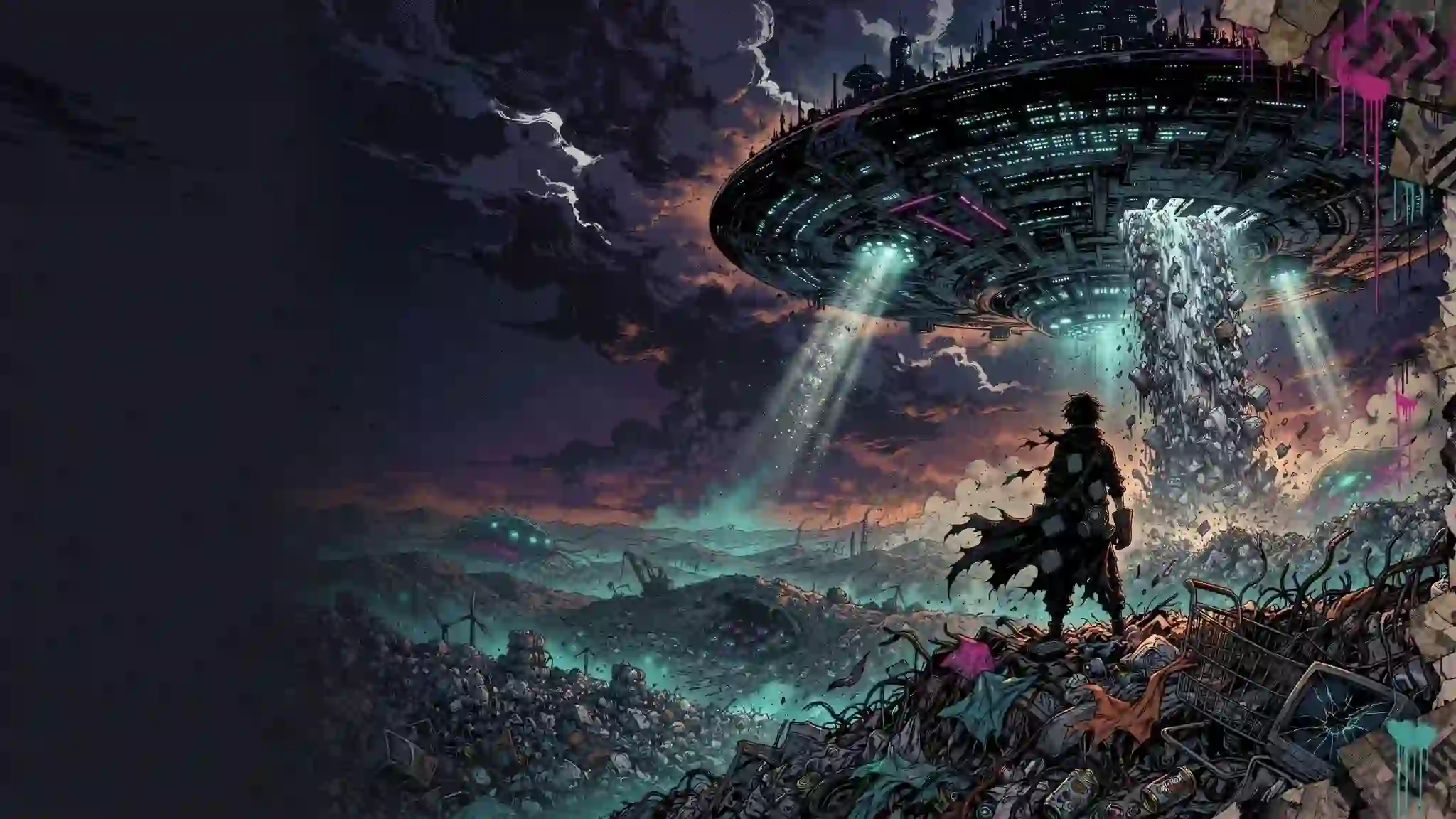
An orphan throws away nothing. A floating city throws away everyone. That single contradiction drives Gachiakuta, the dark fantasy manga that became one of 2025’s most watched new anime and took home three Crunchyroll Anime Awards in 2026. Some readers search for it as Kigachiakuta, which points to the same series.
What Is Gachiakuta in One Short Answer
This guide answers what the title means, where to start, how the Anima system works, and what season 2 changes. Every date and figure below traces back to a Kodansha, BONES FILM, Crunchyroll, or Toonami announcement, then ties into the wider story so the facts stay useful.
Gachiakuta is a dark fantasy shonen manga by Kei Urana, serialized in Kodansha’s Weekly Shonen Magazine since February 16, 2022, with graffiti design by street artist Hideyoshi Ando. A wealthy city called the Sphere dumps its waste, and its criminals, into a wasteland below known as the Pit. Rudo Surebrec, a teenage scavenger from the slums, is framed for murder and thrown down there. He survives, discovers he can awaken souls inside cherished objects, and joins a monster-hunting crew called the Cleaners while planning revenge.
BONES FILM adapted the manga into a 24-episode anime that premiered on July 6, 2025 and streamed worldwide on Crunchyroll. A second season entered production after the finale. The manga reached 19 collected volumes in Japan by July 2026 and won the shonen category at the 50th Kodansha Manga Award in May 2026.
Quick facts at a glance
| Item | Detail |
|---|---|
| Title meaning | “Legit trash” (gachi = serious/legit, akuta = trash) |
| Creator | Kei Urana, with graffiti design by Hideyoshi Ando |
| Publisher | Kodansha, Weekly Shonen Magazine (English: Kodansha USA) |
| Serialization start | February 16, 2022 |
| Japanese volumes | 19 tankobon as of July 2026 |
| English volumes | Vol. 1 on January 16, 2024; Vol. 13 scheduled November 24, 2026 |
| Latest chapter before break | Chapter 173, published August 4, 2026 |
| Manga return | Chapter 174 on November 11, 2026 |
| Anime season 1 | July 6 to December 22, 2025, 24 episodes, BONES FILM |
| Anime season 2 | Confirmed, first-look trailer July 29, 2026, no air date yet |
| English dub | Began October 18, 2026 on Adult Swim’s Toonami block |
| Rating | TV-MA for violence and dark themes |
Why Do People Search Kigachiakuta Instead of Gachiakuta?
Because the title is a pun most readers hear only after they look it up. Gachiakuta is not a dictionary word, so people rebuild it from memory and land on Kigachiakuta, or on a version missing a syllable in the middle. One stray “ki” bolted to the front and you are staring at other people’s guesses.
The spelling that Kodansha uses is Gachiakuta, written ガチアクタ in Japanese and printed as one word with no space. Say it as ga-chi-AK-ta, roughly four beats, with a clean “a” in each syllable rather than a long “ay” sound.
Three quick notes on the naming, all from official material and common fan usage:
- The series is officially one word. “Gachi Akuta” appears in discussions because it is a compound, not because the brand splits.
- “Akuta” also names Rudo’s Cleaners squad, so the second half doubles as a team label.
- The misspelled versions carry no separate meaning, and every one of them points at this same manga and anime.
Getting the spelling right matters more than fans admit. Search engines, store listings, and fan communities all index the correct string, so a misspelled query returns thinner results than the real title deserves.
Who Made Gachiakuta and Why Does It Look Like Street Art?
Kei Urana writes and draws the series. She grew up in Hiroshima, submitted the one-shot Nokase to the Magazine Grand Prix in late 2018, then won first prize in the 103rd Newcomer Manga Award with the one-shot Shikido. Before Gachiakuta began running, she worked as an assistant on Atsushi Ohkubo’s Fire Force. Ohkubo, the creator of Soul Eater and Fire Force, later pointed at Urana and Gachiakuta as the heirs to his own lineage.
The graffiti identity belongs to Hideyoshi Ando, a street artist credited on the manga as graffiti designer. His tags frame chapter pages, mark territory, and carry story information, so the wall art functions as set dressing and as narration at once. That pairing explains a lot of the show’s visual reputation: BONES FILM won Best Character Design and Best Background Art at the 2026 Crunchyroll Anime Awards for translating that look to screen.
Urana’s own origin story for the power system is disarmingly small. As a child she snapped a pen she loved in two and felt, alongside the loss, that the pen was pleading with her. A dry-cleaning hanger from her grandmother later became the visual seed for weapons built from objects nobody else wanted. The thesis of the entire series fits in that anecdote: care creates value, and throwing things away never erases what people felt about them.
What Is the World of Gachiakuta?
Picture a three-layer society made of one building and one basement.
The Sphere floats above everything. Country-sized, self-styled as civilized, it runs on a caste system that separates the wealthy Spherites from the tribesfolk, descendants of criminals who live pinned against the outer wall. Both groups dispose of what they dislike by dropping it over the edge.
The Pit is where the discards land. People convicted of crimes go over the edge too, which turns waste disposal into capital punishment. Spherites treat the place as an uninhabitable dumpster, which is their first and worst mistake.
The Ground is what the Pit calls itself once you live there. Civilizations network across the junk, breathing filtered air and building routines around the constant rain of garbage from above. Toxic patches called polluted zones breed Trash Beasts, monstrous growths powered by accumulated emotion.
Between the two layers sits the Border, a mysterious barrier guarded by an enormous entity residents call the Watchman. Crossing it normally kills a person. That single rule keeps the Sphere’s cruelty comfortably out of sight, and it gives Rudo a route home he has to earn.
The world works because the geography is the argument. Nothing in Gachiakuta needs a monologue about inequality when the rich literally drop their garbage on the poor.
What Is the Gachiakuta Story About?
Rudo Surebrec survives in the slums by rescuing items the Sphere threw out and selling what he can repair. His foster father Regto took him in after Rudo’s biological father, a serial killer, was executed by exile. Neighbors judge Rudo for that bloodline anyway.
Then Rudo comes home to find Regto murdered and a masked intruder carrying off a book. The slums convict him instantly. From the edge of the Pit, he curses every person who called him trash and swears he will climb back up.
Enjin, a Cleaner with an umbrella for a weapon, pulls him out of a Trash Beast attack and puts him through a cruel job interview at a truck stop. Rudo bites off two fingers, survives, and is told he qualifies as a Giver. He accepts the Cleaners’ offer for one reason only: access to whoever might know the way back to the Sphere.
The manga then escalates in clean steps. Rudo learns the Ground’s politics, gains a mask, a team, and friends he refuses to admit he needs. The Raiders, a criminal organization led by Zodyl Typhon, hunt him because his gloves belong to a legendary set of weapons. The story moves from survival, to faction war, to a conspiracy about who built this two-tier world and why the Watchman guards the door.
Long-running arcs mark that climb: the Raiders confrontations, the Penta and Tori No Man’s Land expeditions, the Information Broker arc built around a knowledge dealer named Kuro, and the Doll Festival arc that ran for well over a year before closing at chapter 173.
Who Are the Main Characters in Gachiakuta?
| Character | Role | Object weapon | Voice (JP / EN) | Why they matter |
|---|---|---|---|---|
| Rudo Surebrec | Cleaner, team Akuta | Watchman Gloves (3R) | Aoi Ichikawa / Bryson Baugus | Awakens power in discarded objects and can hold three at once |
| Enjin | Cleaner, team Akuta | Umbrella | Katsuyuki Konishi / not yet confirmed | Finds Rudo, tests him, and recruits him |
| Zanka Nijiku | Cleaner, team Akuta | Staff | Yoshitsugu Matsuoka / not yet confirmed | Rudo’s rival-turned-trainer, anxious and precise |
| Riyo Reaper | Cleaner, team Akuta | Scissors, the Ripper (used with her feet) | Yumiri Hanamori / not yet confirmed | Cheerful front line, brutal combat instincts |
| Regto | Rudo’s foster father | Watchman Book (mentioned) | Toshiyuki Morikawa / John Burgmeier | His death starts everything, and his book is the stolen object |
| Semiu Grier | Cleaner receptionist | Glasses | not yet confirmed | Her lenses read a person’s true nature |
| Arkha Corvus | Cleaners’ boss | not yet confirmed | not yet confirmed | Welcomes Rudo and knows about Border survivors |
| Gris, Follo, Tomme | Supporters | Gris’s talisman | not yet confirmed | Non-combat crew who keep Givers alive |
| Tamsy Caines, Delmon Ossa | Cleaners, team Eager | Spindle and hose nozzle | not yet confirmed | Comic weight and heavy support work |
| Bro, Dear, Guita | Cleaners, team Child | Bandana, pacifier, monster suit | not yet confirmed | Child Givers, the series’ tenderest provocation |
| Zodyl Typhon | Raiders’ leader | Watchman Coat, Mishra | not yet confirmed | Wants every Watchman piece and the Sphere’s fall |
| Jabber, Cthoni, Bundus | Raiders | Clawed instrument, portals, borrowed power | Ryosei Tanaka as Jabber (stage) | The escalating threat after the Trash Storm |
| Amo Empool | No Man’s Land guide | Watchman Boots | not yet confirmed | Knows the Border and the Sphere’s secrets |
| Kuro | Information broker | Information network | not yet confirmed | Season 2’s announced center of gravity |
| Chiwa | Rudo’s past | none | not yet confirmed | Betrays him publicly and proves the slums are no kinder |
| Canis Surebrec | The Undertaker, six generations back | All Watchman pieces | not yet confirmed | Ancestor whose name Rudo shares |
How Does the Gachiakuta Power System Work?
The system runs on Anima, energy produced by human thought and emotion. Japanese text writes it as “shinen,” roughly “lingering thoughts.” Ordinary weapons bounce off Trash Beasts because those creatures regenerate. Only a weapon with a soul can end them.
A Giver supplies that soul. Someone who pours years of care into an object can wake it up as a Vital Instrument, called Jinki in Japanese. A mended umbrella becomes a shield and a tailor’s shears become a blade. A pair of scissors worked with the feet, a shopkeeper’s staff, even the filthy toilet plunger Rudo grabs in his first real fight: the object stays itself, and that is the joke and the point.
Rules worth knowing before you judge a fight:
- Care scales power. The longer and more honestly a Giver looks after an object, the stronger the instrument.
- Intent sets the role. A Giver who wants offense gets an Attacker type. A Giver who wants to protect something gets a Defender type that cannot strike at all.
- The bond is exclusive. Another person holding your Jinki usually gets a dead object.
- Names appear on the metal. Awakening etches the Giver’s name, and hiding it lets a fighter hold power in reserve.
- Recoil is real. Pushing an instrument past its limit costs the user, sometimes sight or sanity.
- Succession is the rare tier. Objects passed down generations accumulate multiple Givers’ Anima.
Rudo breaks the rules on purpose. He revives instruments that other people discarded, and he can carry three at once or focus all his output into one for a raw multiplier. Every weapon he borrows crumbles after use, so his fighting style is a running refusal to let anything worthless die twice.
What Are the Watchman Series and Why Does Everyone Want Them?
The Watchman Series is a set of ancient Vital Instruments said to date back at least six generations, each holding an effectively unlimited Anima supply. They read as the oldest known instruments in the world, and their symbol matches the sigil of Canis Surebrec, the Undertaker, who owned the complete set.
Their catch is cruel. A mentally stable person who grips one tends to lose their mind. Only someone already broken by loss can carry the weight without collapsing, which turns the series into a curse that punishes the wounded for being strong.
Pieces currently tracked by readers, with the sense each one echoes:
- Gloves, tied to touch. Rudo’s inheritance. Awaken discarded objects, empower up to three instruments, or stack output into one.
- Boots, tied to smell. Held by Amo. They release the scent of a person their target loves and weaponize that recognition.
- Coat, tied to taste. Worn by Zodyl Typhon under the name Mishra. It mutates his body into whatever he has eaten, including wings.
- Book, tied to sight. Taken from Regto on the night he died. Readers believe it edits memory, and the trail points toward team Eager.
The Border itself deepens the mystery. A dying Raider in the anime’s finale states plainly that the Border is the Watchman, and readers keep debating whether that entity is the source of the series rather than its owner. Follo’s line about a mind being “eaten away at” near the entity, and Noerde’s fate in the same scene, keep that reading alive.
Where Can You Watch Gachiakuta and What About the Dub?
Crunchyroll holds the global streaming license and released the season as a simulcast, and industry reporting placed it as the platform’s most-viewed new title in July 2025. Medialink covers Southeast Asia through the Ani-One Asia channel, and Prime Video and Apple TV list the season for purchase in some regions.
The English dub arrived in two waves. Crunchyroll published dubbed episodes a few weeks behind the Japanese broadcast, and Adult Swim’s Toonami block began airing the dub on October 18, 2026, which put Gachiakuta in front of American television audiences for the first time.
Season 2 holds the same shape with fewer specifics. BONES FILM confirmed it in the season 1 finale, showed a first-look teaser at Anime Expo on July 3, 2026, and released a full first-look trailer on July 29, 2026. Crunchyroll will stream it. No premiere date, episode count, or dub window has been announced, so treat late 2026 or 2027 as educated waiting rather than a scheduled event.
Cast and crew, unchanged between seasons:
- Director: Fumihiko Suganuma
- Series composition and scripts: Hiroshi Seko
- Character design and chief animation direction: Satoshi Ishino
- Music: Taku Iwasaki
- Studio: BONES FILM
- Rudo: Aoi Ichikawa
- Enjin: Katsuyuki Konishi
- Zanka: Yoshitsugu Matsuoka
- Riyo: Yumiri Hanamori
- Regto: Toshiyuki Morikawa
Theme songs carry the punk attitude the manga started with. Paledusk performs the first-cour opener “HUGs,” DUSTCELL closes it with “Tomoshibi,” Mori Calliope sings the second-cour opener “Let’s Just Crash,” and Karanoah performs the closer “Ban.”
Should You Read the Manga or Watch the Anime First?
Watch the anime, then read from chapter 1. Season 1 runs 24 episodes and carries the story from Rudo’s fall through the Trash Storm and the aftermath in Canvas Town, so the animation teaches you the world, the tone, and the combat grammar before you commit to 173 chapters.
Read the manga when you want the full picture. Urana packs detail into corners that the anime flattens, and the printed page keeps the graffiti exactly where she placed it.
Five steps that work for a new reader:
- Watch season 1, episodes 1 to 24, subtitled or dubbed.
- Start the manga at chapter 1 even if you stopped the anime midway, since the adaptation compresses.
- Read the volume covers in order; they function as chapter epilogues and carry arc clues.
- Jump to chapter 170 onward to catch “A Bolt from the Blue” and what follows before the break.
- Pick up the English editions as Kodansha USA publishes them, then revisit the manga’s extra chapters that never made it into the anime.
What Is the Gachiakuta Reading Order and Chapter Status?
One order only: chapter 1 forward. There is no sequel manga, no spinoff you need, and no prequel that recontextualizes Rudo’s fall.
The Japanese edition reached 19 volumes by July 16, 2026. Kodansha USA launched the English line in March 2023 with volume 1 arriving January 16, 2024, then moved to a regular cadence with volume 12 on September 22, 2026 and volume 13 scheduled for November 24, 2026. Volume 14 is dated January 12, 2027 in the English schedule. Jennifer Ward translates and Jamil Stewart letter the English volumes.
Publication status matters more than usual right now:
- Chapter 173, titled “Forget Something?”, ran on August 4, 2026 and closed the Doll Festival arc.
- Weekly serialization then paused for what became the manga’s longest break since 2022.
- Urana announced on October 15, 2026 that chapter 174 returns on November 11, 2026, describing the gap as research time ahead of a new arc.
- No end date exists. The series is ongoing with the story deliberately still mid-climb.
Manga publication snapshot
| Volume | Japanese release | English release | Notes |
|---|---|---|---|
| 1 | May 17, 2022 | January 16, 2024 | Rudo framed, thrown to the Ground, recruited by Enjin |
| 5 | February 17, 2023 | 2024-2025 window | Rudo’s revenge thread and the return-to-the-Sphere plan |
| 9 | December 15, 2023 | January 20, 2026 | Cleaner HQ life and Rudo’s first real assignments |
| 12 | September 17, 2024 | September 22, 2026 | Forest No Man’s Land and the Box |
| 13 | December 17, 2024 | November 24, 2026 | The Box opened, Elder revealed |
| 15 | June 17, 2025 | pending | “Explosion” and Rudo’s integration into the team |
| 16 | September 17, 2025 | pending | Doll Festival begins |
| 17 | November 17, 2025 | pending | Mymo the Ruler’s spotlight |
| 18 | February 17, 2026 | pending | The Ancient Rulers surface and “The Kind and The Gentle Avenger” |
| 19 | July 16, 2026 | pending | Doll Festival climax, chapters 161 to 169 |
| Uncollected | chapters 170 to 173 | pending | Return scheduled November 11, 2026 |
What Do Critics and Sales Say About Gachiakuta?
Sales followed the anime rather than preceding it. Kodansha has not published a lifetime circulation figure, but Oricon’s 2026 annual report credits the manga with over 400,000 physical copies sold in Japan. In North America, volumes sat on Circana BookScan’s monthly top 20 adult graphic novels list beginning in July 2025, and volume 1 held a place on the New York Times Graphic Books and Manga monthly bestseller list from February through July 2026.
The award shelf did the rest of the convincing:
- 2022 Next Manga Award: 13th in the print category, and first among English-speaking voters while no official English release existed.
- 2023 and 2024: nominee for the shonen category at the 47th and 48th Kodansha Manga Awards.
- 2026: winner in the shonen category at the 50th Kodansha Manga Award, Japan’s oldest major manga prize.
- 2026 Crunchyroll Anime Awards: Best New Series, Best Character Design, and Best Background Art, with Anime of the Year going to My Hero Academia’s final season.
- Review aggregation: a 100 percent Tomatometer score on Rotten Tomatoes from seven reviews, with a 93 percent audience rating, so read the critic number as a small sample rather than a verdict.
Critics keep landing on the same note. The Hindu’s review describes a show that “thrums with a punk-rock, heavy-metal restlessness,” while AV Club praises it for genuinely embracing graffiti culture instead of borrowing its look. Common Sense Media scores it 3 out of 5 and warns parents that episode 13 handles trafficking in a way that hits hard.
What Are the Main Themes in Gachiakuta?
Waste as a moral choice. The Sphere’s sin is not pollution. It is the belief that anything, including a person, can be declared finished. Rudo’s habit of repairing what others abandon answers that belief with his hands.
Value created by attention. Anima makes the argument literal. A cared-for coat outranks a brand-new rifle because time and feeling are the actual fuel.
Inherited guilt and inherited names. Rudo carries a serial killer’s surname, then learns a far older one belongs to him. Bloodline in this story is a claim other people make about you, and taking it back is the whole plot.
Found crew over chosen revenge. Rudo starts the series wanting to kill his accusers. He keeps going because Gris thanks him, Zanka apologizes, and a child Giver named Dear treats him like a normal person.
Art as record. Graffiti tags mark territory, store history, and outlive the people who paint them, which is how Canvas Town preserves six generations of Spellcasters on one mural.
Who gets to be clean. The Cleaners tidy a world the Sphere made filthy and get no credit for it. Giving a janitorial job a heroic title is the series’ sharpest little trick.
How Has Gachiakuta Influenced Anime and Street Culture?
The series turned junk into a fashion language. Spherical silhouettes, patched coats, work gloves, respirators, oversized boots, and spray-painted sigils moved from pages into cosplay, thrift-flavored streetwear hauls, and artist pages within a year of the anime premiere. That crossover worked because the costume design follows function: every item on screen was garbage before somebody loved it.
Graffiti got a similar upgrade. Ando’s lettering sits inside the storytelling rather than on top of it, so readers treat tags as map, memorial, and message. Street artists and tattoo flash designers picked up the vocabulary, and cover reveals now generate the kind of reaction that used to belong to trailer drops.
Other media followed fast:
- A stage play ran at the Stellar Ball in Tokyo from May 22 to 26 and 29 to 31, 2026, then at the Rohm Theater in Kyoto from June 5 to 7, with Go Ueki directing and Watashiomu writing.
- Com2uS announced a console and PC adaptation, released under the title Gachiakuta: BREAKOUT, a survival action RPG for PlayStation 5, Xbox Series X|S, and Steam with a 2027 window and gameplay shown during the Xbox Tokyo Game Show 2026 stream on September 17, 2026.
- Storm: Earth’s Mightiest Mutant issue 4 alluded to the manga, and Urana acknowledged the nod, which told fandom how far the series’ reach now stretches.
- Chapter reaction threads, edit pages, and subreddit discussions grew into one of the most active communities around any 2025 debut, with r/gachiakuta counting roughly 39,000 members and daily chapter megathreads during serialization.
What Is Next for Gachiakuta in 2027?
Season 2 leads the queue. BONES FILM has active production rather than a promise, the first-look trailer confirms Rudo’s expanding abilities, and the reported adaptation target is the Information Broker arc, which pulls the story from survival into espionage. Director Suganuma called the pivot “a big pivot” with “a lot of growth” at Anime Expo 2026, and the arc centers on Kuro, the Ground’s most complete information dealer, whose method is being everywhere important rather than knowing everything.
Here is where every front stands right now:
- Manga: chapter 174 resumes serialization on November 11, 2026 after the longest break of the run.
- Volume 20: unannounced in Japan. Kodansha shipped 17, 18, and 19 in November 2025, February 2026, and July 2026, so a late 2026 or early 2027 date would fit the pattern once serialization resumes.
- Anime season 2: no date. A 12 to 18 month production cycle for a two-cour season is the standard estimate, so 2027 remains the practical window.
- English volumes: 13 on November 24, 2026 and 14 on January 12, 2027, which keeps the translation roughly seven volumes behind Japan.
- Game: Gachiakuta: BREAKOUT, survival action RPG, PS5, Xbox Series X|S, and Steam, 2027.
- Stage: no encore announced after the 2026 Tokyo and Kyoto run.
- Movie: nothing confirmed, despite the franchise’s awards momentum.
What Do Viewers Get Wrong About Gachiakuta?
Six corrections save newcomers real time.
- “It is a Demon Slayer copy.” The revenge-and-monsters skeleton is shared, yet the object-soul power system and the class argument have no equivalent in that series.
- “Rudo is just an angry protagonist.” His anger starts the plot and then loses the wheel. Repair, loyalty, and guilt do the actual work.
- “The trash theme is an environmental sermon.” Discarding is treated as a moral act aimed at people, not a recycling PSA.
- “You need to read 170 chapters to enjoy the anime.” Season 1 is a complete two-cour story with a hard landing and a season 2 teaser attached.
- “The manga is finished soon.” It is ongoing, with no announced end, and a planned research break is not cancellation.
- “Kigachiakuta is a different series.” It is the same franchise, misspelled.
How Should a Site Build a Topical Map Around Gachiakuta?
One page cannot own this topic, and Google does not expect it to. Authority comes from a cluster that answers every follow-up question a reader has after landing here, each page linking back to this hub.
Six clusters cover the demand that sits behind the phrase Gachiakuta:
- Entry cluster: what is Gachiakuta about, how many chapters, how far ahead is the manga, is Gachiakuta finished, where to start.
- Meaning cluster: the gachi and akuta translation, the Watchman sigil, why a Cleaners squad is called Akuta, the pronunciation guide.
- System cluster: Anima explained, Attacker versus Defender Jinki, every Watchman Series item, recoil rules, Succession.
- Character cluster: Rudo’s arc and gloves, Enjin’s test, Zanka’s staff, Riyo’s Ripper, the Child team, Zodyl Typhon, Kuro, and the Surebrec bloodline.
- Season 2 cluster: broadcast window, arc coverage, new cast, dub schedule, what the Anime Expo trailer revealed and what it hid.
- Culture cluster: Hideyoshi Ando’s graffiti language, the costume code, the stage play, Gachiakuta: BREAKOUT, and the sales charts that track the franchise’s climb.
Two rules keep the cluster healthy. Every child page answers one intent in its title and never repeats the hub’s quick answer word for word. And every page cites the same three primary sources, because search engines reward clusters where the underlying records match.
Frequently Asked Questions About Gachiakuta
What does Gachiakuta mean in Japanese?
Gachiakuta combines gachi, slang for “seriously” or “legit,” with akuta, meaning trash. Kodansha prints the title as one word, ガチアクタ, so the cleanest translation is “legit trash,” a name for both the weapons and the people the Sphere throws away.
Is Gachiakuta worth watching in 2026?
Yes, if dark fantasy shonen with a strong visual identity interests you. Season 1 runs 24 episodes, streams worldwide on Crunchyroll, won Best New Series at the 2026 Crunchyroll Anime Awards, and ends on a cliffhanger that season 2 will pick up.
How many chapters of Gachiakuta are there?
173 chapters were published before the serialization pause, with chapter 174 scheduled for November 11, 2026. Kodansha has collected 170 of them into 19 Japanese volumes, and chapters 170 to 173 remain uncollected.
Is Kigachiakuta a separate anime?
No. Kigachiakuta is a misspelling of Gachiakuta. Search engines treat the two strings as the same intent, so use the correct spelling to find full volume lists, dub schedules, and chapter releases.
Where do I start reading Gachiakuta?
Start at chapter 1 and read forward, since there are no spinoffs to place in the order. Watch the 24-episode anime first if you want the fastest route in. English readers can buy volumes 1 through 12 now, with 13 arriving November 24, 2026.
Is Gachiakuta suitable for younger viewers?
No. It is rated TV-MA for graphic violence, blood, grief, and references to trafficking, and Common Sense Media suggests it for ages 15 and up. Older teens who read horror manga will handle it. Younger children will not.
Ready to Fall Into the Pit?
Gachiakuta earned its place by refusing to look away from the things other shonen series step around: class rage, inherited shame, and the strange love hidden inside cheap objects. Twenty-four episodes, nineteen volumes, one award-winning production team, and one season 2 in active production mean you can start tonight and still land ahead of the next hype wave.
Do this now. Queue episode 1, “The Sphere,” and give it three episodes before you decide anything. Read the first five chapters afterward to see how Urana paces a fight on paper. Pick one object you own that should have been thrown away years ago and understand exactly why Rudo can’t let go of his gloves.
Then tell us what you want next: a chapter-by-chapter Watchman Series tracker, a breakdown of the Information Broker arc before season 2 lands, or a starter guide to the graffiti style that made this series impossible to miss. Your next favorite obsession is sitting in the trash where the Sphere left it.