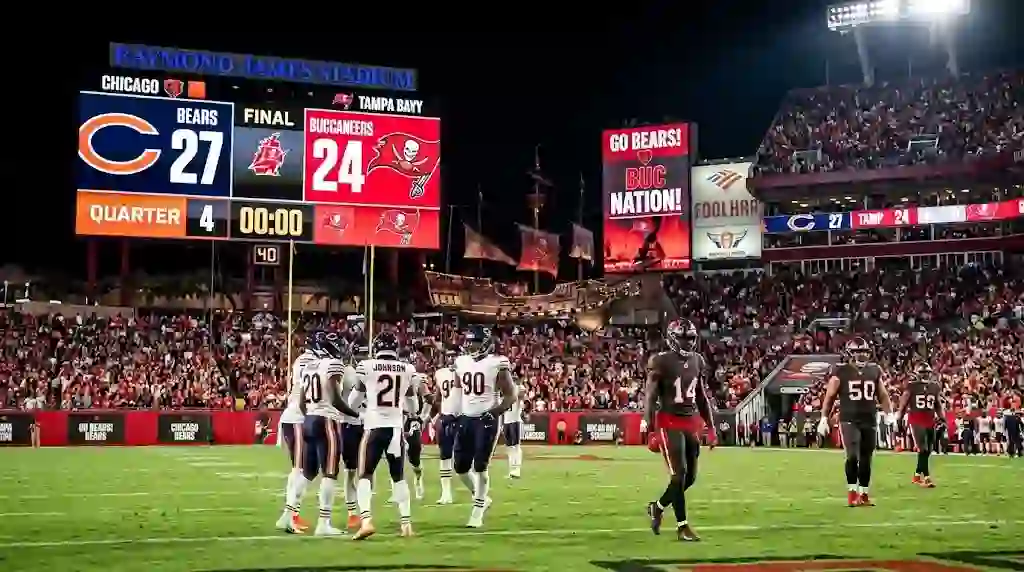
Open any score app after a game and you get the headline: who won, by how many, and maybe a leading passer. That summary is quick, but it hides the details that actually explain a result. The most recent meeting between these two franchises is a perfect example. Chicago won 27-24 on Sunday Night Football, yet the team that lost the game forced five turnovers and finished with more total yards.
That contradiction is why the Tampa Bay Buccaneers vs Chicago Bears match player stats deserve a closer look. Third-down efficiency, pressure rates, field position and turnover timing explain far more than a final score can. This guide walks through every key matchup at Soldier Field, compares the players head to head, and adds the latest roster and series updates so you are reading current information instead of recycled numbers.
Latest Updates: What Changed Before and During the Newest Meeting
The Week 9 game in the 2026 season reshaped the picture of this matchup. Here is the quick version of what is new.
- Final score: Chicago 27, Tampa Bay 24, decided by a 38-yard Cairo Santos field goal as time expired.
- Records afterward: The Bears moved to 7-2 and the Buccaneers dropped to 3-6.
- Yardage: Tampa Bay finished with 352 total yards against 349 for Chicago, which shows how thin the margin was.
- Turnovers: The Buccaneers took the ball away five times, including four interceptions of Caleb Williams, but lost the turnover fight on their own mistakes, including a 67-yard pick-six.
- Roster shifts: Mike Evans left for San Francisco, Lavonte David retired, D.J. Moore was traded to Buffalo, and Chicago added defensive tackle Jeffery Simmons in a blockbuster trade. Many older stat lines no longer reflect the rosters on the field.
- Coaching: Ben Johnson now runs the Bears in his second season, while Zac Robinson calls plays for Tampa Bay and Danny Smith leads the special teams unit.
Keep these changes in mind, because several players who dominated earlier editions of this series are no longer involved.
Why Player Stats Reveal More Than the Final Score
Consider what the box score would have suggested at halftime. Chicago led 17-6 and had outgained Tampa Bay 240 to 189. A casual viewer would have written the Bucs off. But the raw yardage was misleading, because Williams had already thrown interceptions that kept the game within reach, and the visitors were forcing mistakes at a pace that rarely holds up in the NFL.
Individual numbers expose these swings. A quarterback can pass for 279 yards and still hurt his team with four interceptions. A back can carry only 12 times for 31 yards and still help in other ways. A kicker can go home with three field goals and watch his team lose anyway. Coaches review exactly this layer of detail every week, because the scoreboard says who won while the player data says why.
Two team-level indicators framed this game before kickoff. Tampa Bay led the league in rushing offense at roughly 168 yards per game but ranked last in passing yards per game. Chicago ranked first in third-down defense, allowing conversions on under a quarter of attempts. When a ground-first offense meets the stingiest third-down defense, the efficiency of each individual play matters more than anything else.
Tampa Bay Buccaneers vs Chicago Bears Match Player Stats at Quarterback
Quarterback play shaped this game more than any other factor, though not in the way the matchup suggested. Both passers produced big plays and big mistakes, and the two stat lines read almost like mirror images.
Baker Mayfield: Efficient Moments, Costly Errors
Baker Mayfield finished 18 of 32 for 243 yards with two interceptions. He was sacked four times, including back-to-back sacks on a fourth-quarter possession that stalled Tampa Bay’s chance to build on its momentum. The Bucs converted only two of twelve third downs, which put extra weight on Mayfield’s explosive throws.
Those throws were impressive. He scrambled to find Kenny Gainwell for a 44-yard gain and later launched a 58-yard strike to Tez Johnson that set up a Bucky Irving touchdown. He also ran in the two-point conversion that tied the score at 24 with 2:51 remaining. The problem came when he threw a pass that Jaylon Johnson returned 67 yards for a touchdown, a seven-point swing that cost the Bucs dearly.
Context helps here. Before this game, Mayfield had passed for 679 yards that season, and Tampa Bay’s passing offense ranked at the bottom of the league. Against Chicago he produced a season-high 226 net passing yards, a sign that the offense is gradually widening beyond its run-heavy identity.
Caleb Williams: Elite Production, Historic Mistakes
Caleb Williams completed 22 of 37 passes for 279 yards and two touchdowns, but he also threw four interceptions, the most he has ever thrown in a single game at any level. Entering the night he was part of the MVP conversation, carrying a passer rating of 104.6 and a 6-1 touchdown-to-interception ratio.
His two touchdown passes were beautiful. The first was a nine-yard throw to Rome Odunze to finish the opening drive. The second was a short pass to Luther Burden III that turned into a 56-yard score after Burden broke several tackles. Those two plays showed the ceiling of this offense. The four picks showed the risk, since Tampa Bay defenders converted nearly every mistake into a turnover.
Touchdown-to-Interception Balance
The balance between touchdowns and interceptions tells the story neatly. Mayfield produced zero passing touchdowns and two interceptions, though he added points with his legs. Williams produced two touchdowns and four interceptions. Neither number looks flattering, which explains why a game with so many giveaways stayed within three points. Chicago won mostly because its mistakes came at moments when the Bucs could not cash in, while Tampa Bay’s two costly picks created points directly for the home team.
Running Back Battle: Ground Game Stats That Shifted Momentum
The ground game was supposed to define this matchup, and it did. Tampa Bay entered with the top rushing attack in the league, and Chicago owned the second-best. The two defenses ranked in the top four against the run as well. Something had to give.
Bucky Irving and the Buccaneers Backfield
Bucky Irving was Tampa Bay’s most productive offensive player. He carried 20 times for 97 yards and two touchdowns, adding four catches for 28 yards. His first score came on a two-yard toss on the opening drive of the second half, and his second came from six yards out to set up the tying two-point play. That works out to roughly 4.9 yards per carry against a defense that ranks near the top of the league in run stopping.
Kenny Gainwell served as a useful change-of-pace option. His 44-yard reception on a scramble drill was the longest play of the first half for Tampa Bay. The week before, the Bucs had rushed for 324 yards without completing a single pass in a shutout, so the Bears prepared for a ground-heavy plan and still struggled to contain it for four quarters.
D’Andre Swift and the Chicago Ground Game
D’Andre Swift had a quiet night by his standards, finishing with 12 carries for 31 yards. That is about 2.6 yards per attempt, a sharp drop from the pace that gave him 545 rushing yards and 10 touchdowns before kickoff. Tampa Bay’s front, anchored by Vita Vea in the middle, shut down interior running lanes and forced Chicago to lean on the passing game.
Rushing Efficiency Comparison
Tampa Bay won the rushing battle in a meaningful way. Irving alone outgained Swift by 66 yards. That edge forced the Bears to defend the run honestly, which opened the play-action game that produced Tampa Bay’s long gains. Even so, the Bucs could not turn a ground advantage into a victory because turnovers erased it.
Wide Receiver and Tight End Production
The receiving corps for both teams looks different from the version fans remember. Evans is gone, Moore is gone, and younger names have taken over.
Buccaneers Receivers
Tez Johnson led Tampa Bay in receiving yards with just two catches for 76, powered by the 58-yarder and an 18-yard out in the second quarter. Emeka Egbuka, the team’s leader in receptions this season, returned after missing two games with a foot injury. Chris Godwin remains the veteran chain-mover, with 243 receiving yards entering the game. Cade Otton continues to make his mark as a blocker, a skill that coaches credit for the creases opened in the run game over the previous two weeks.
Luther Burden III and Rome Odunze: Chicago’s Young Targets
Burden was the best receiver on the field. He caught seven passes for 97 yards and a touchdown, even though a fumble complicated his night. Odunze added four catches for 60 yards and a touchdown. Entering Week 9, Burden had 42 receptions for 547 yards, and tight end Colston Loveland had 33 catches for 309 yards. Chicago’s passing offense now relies on a younger, more explosive group than the one that faced Tampa Bay in recent years.
Tight End Impact
Loveland has become the primary tight end option in Chicago after Cole Kmet went to injured reserve. For Tampa Bay, Otton’s value shows up in blocking numbers rather than the box score. Both players matter in short-yardage and red-zone situations, where the difference between a touchdown and a field goal often decides a close contest.
Defensive Player Stats That Swung the Outcome
If you want to know why this game was so close, look at the defensive column. It was the busiest part of the stat sheet.
Secondary Coverage and Interceptions
Zyon McCollum had the standout defensive performance for Tampa Bay, collecting five tackles and two interceptions, both in the first half. That raised his season total to four. Safety Tykee Smith also picked off Williams, returning it 23 yards to set up a possession deep in Chicago territory, and linebacker Alex Anzalone added another interception in the third quarter. Four interceptions of one quarterback in a single game is rare, and the Bucs also recovered a fumble forced by rookie defensive back Keionte Scott, a play that led directly to the tying touchdown.
For Chicago, Jaylon Johnson delivered the game’s most dramatic defensive play with his 67-yard pick-six. Safety Cam Lewis finished with six tackles and an interception.
Pass Rush and Sack Numbers
Chicago’s front, which ranked second in the league in sack rate entering the night, recorded sacks from Jeffery Simmons and Austin Booker. Mayfield was sacked four times for 17 yards. Simmons, who arrived through a trade just before the deadline, has already made his presence felt. He recorded a sack against Seattle the previous week and continued to disrupt Tampa Bay’s protection plans.
Tampa Bay’s pass rush was less visible in the sack column, partly because outside linebacker Yaya Diaby missed the game with a knee injury. Even so, steady pressure helped create the mistakes that led to Williams’ four interceptions.
Special Teams Stats Most Fans Overlook
Special teams played an outsized role in a game decided by a single kick.
Cairo Santos made both of his attempts, a 25-yarder in the second quarter and the game-winning 38-yarder as time expired. Chase McLaughlin answered with three field goals of 27, 21 and 35 yards for Tampa Bay. McLaughlin entered the night as the league leader in points among kickers, so the Bucs could count on him in tight spots.
Return and coverage units also created swings. Chicago’s Zavion Thomas gave the Bears a 40-yard kick return early, then appeared to score on a 91-yard return that a holding penalty wiped out. Later, Miles Killebrew got a hand on a punt, limiting Chicago to a 24-yard kick and handing Tampa Bay possession near midfield. These hidden-yardage plays often decide close games, and this one was no exception.
Head-to-Head Player Stats Comparison Table
The table below places the major performers side by side using the latest meeting.
| Player | Team | Position | Stat Line | Key Takeaway |
| Baker Mayfield | Buccaneers | QB | 18/32, 243 yds, 2 INT | Added a two-point run; sacked 4 times |
| Caleb Williams | Bears | QB | 22/37, 279 yds, 2 TD, 4 INT | Career-high interceptions |
| Bucky Irving | Buccaneers | RB | 20 att, 97 yds, 2 TD; 4 rec, 28 yds | Top Tampa Bay offensive performer |
| D’Andre Swift | Bears | RB | 12 att, 31 yds | Held to about 2.6 yards per carry |
| Tez Johnson | Buccaneers | WR | 2 rec, 76 yds | 58-yard deep strike |
| Luther Burden III | Bears | WR | 7 rec, 97 yds, 1 TD | 56-yard touchdown after the catch |
| Rome Odunze | Bears | WR | 4 rec, 60 yds, 1 TD | Opening-drive touchdown |
| Zyon McCollum | Buccaneers | CB | 5 tackles, 2 INT | Both picks came in the first half |
| Jaylon Johnson | Bears | CB | 1 INT, 67-yd return TD | Biggest single swing of the game |
| Cairo Santos | Bears | K | 2 FG including 38-yd winner | Won the game at the gun |
| Chase McLaughlin | Buccaneers | K | 3 FG (27, 21, 35 yds) | Kept Tampa Bay within reach |
Treat these as a snapshot of one game rather than a forecast. Weather, injuries and game script can move individual totals significantly from week to week.
All-Time Head-to-Head Series Comparison
Stat lines tell one part of the story, but the larger series record adds perspective.
| Category | Detail |
| Total meetings | 63 including the latest game |
| Series leader | Chicago, with a 41-22 edge |
| Since 2002 (post-realignment) | Chicago leads 8-6 |
| Most recent result | Bears 27, Buccaneers 24 (Week 9, 2026) |
| Previous meeting | Buccaneers 27, Bears 17 in Tampa (2023) |
| Largest Bears win | 48-10 in 2018 |
| Largest Buccaneers win | 41-0 in 2000 |
Tampa Bay had won four of the six meetings since 2016 before this game, and the Bucs scored at least 27 points in each of those victories. Chicago’s latest win tightens the recent balance, leaving the Bucs with four wins in seven matchups over that stretch.
What to Watch in the Next Meeting
Based on the numbers above, a few indicators will tell you who controls the next game before the scoreboard does.
First, watch third-down conversion rates. Tampa Bay’s 2-for-12 performance was the single biggest reason a dominant ground attack never produced a comfortable lead. Second, track turnover timing, not just turnover count. Five takeaways should win most games, but Tampa Bay’s two interceptions of its own led to a seven-point swing and a short field. Third, follow Williams’ decision-making against disguised coverages. His arm talent is obvious, but the interceptions suggest there is still room for growth in processing pressure.
The Final Word on These Player Stats
The newest chapter in this rivalry proves why raw totals rarely tell the full story. Tampa Bay out-gained Chicago, won the turnover battle 5-1 on defense alone, and still lost on a field goal as the clock expired. Individual performances from Irving, McCollum, Burden and Williams explain both the closeness of the game and the way it slipped away.
If you follow the Tampa Bay Buccaneers vs Chicago Bears match player stats going forward, focus on efficiency, situational football and who protects the ball when it matters. The team that wins those small battles will keep winning the large one, and these numbers will help you see it coming.