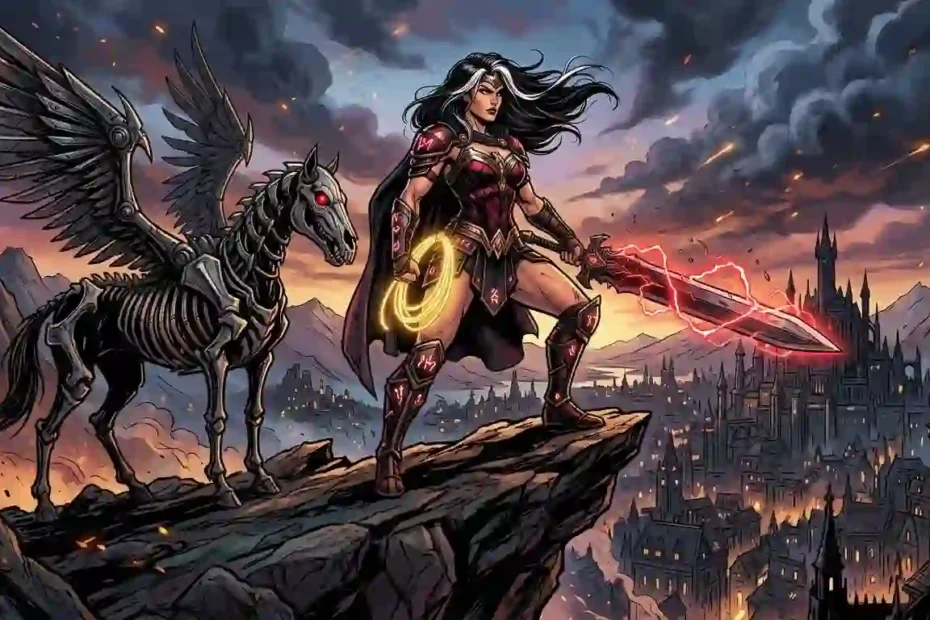
You search for Wonder Woman and find a darker, taller, magic-wielding Diana who grew up in Hell. You wonder if this is still the same hero you love. That confusion stops many new readers from starting the series. This complete guide answers every question about absolute wonder woman with clear facts, direct explanations, and official sources so you read with confidence.
What Is Absolute Wonder Woman? The New DC Origin Explained
This fresh incarnation reimagines Diana of Themyscira for DC’s Absolute Universe. DC launched this imprint after the Absolute Power event in 2024. The line asks what happens when heroes lose their traditional advantages and still choose heroism.
In this continuity, Diana does not grow up on Themyscira. Apollo takes her as a baby to the underworld. Circe, traditionally her enemy, raises her. She grows up without Amazon sisterhood, without paradise, without a mission of peace. She still chooses compassion. That choice defines her.
This new version debuted on October 23, 2024. Writer Kelly Thompson and artist Hayden Sherman lead the series. It has earned Eisner Awards for Best New Series and Best Coloring 1. DC lists the series as ongoing with 23+ issues and an annual 2.
The Absolute Universe removes safety nets. Bruce Wayne has no fortune. Kal-El has no Fortress. Diana has no island. You see who they become when nothing comes easy. You understand why fans call this Diana the Absolute Amazon.
Key differences you notice immediately:
- Diana is the last Amazon, not one of many
- Her powers come from witchcraft and Hell-forged weapons
- She protects Gateway City, not Washington D.C.
- She rides a giant skeletal winged horse
- She faces horror-inspired threats from the first issue
Readers who felt overwhelmed by decades of continuity now have a clean entry point. You start at issue one. You learn everything alongside Diana. You feel her isolation and her determination.
Who Created This Series? Meet the Team Behind the Comic
Kelly Thompson writes the series. Thompson won an Eisner and built her reputation on character-driven superhero stories like Hawkeye, Black Widow, and Birds of Prey. She centers emotion, humor, and clear motivation. She wanted Diana to feel like the biggest, kindest person in any room.
Hayden Sherman draws the main series. Sherman brings a sharp, expressive style with bold panel layouts inspired by Greek pottery patterns. Action feels fluid and mythic. Sherman designs gods, monsters, and armor with striking silhouettes. Jordie Bellaire colors the book and won an Eisner for her work on this title. Her palette mixes deep reds, Hell oranges, and cold blues. Becca Carey letters the series with clean, readable balloons.
The creative team intentionally made Diana larger and more mythic. Thompson confirmed in interviews she wanted Diana to tower over others. That creative decision shapes both story and design. The team also includes guest artists like Mattia de Iulis, Dustin Nguyen, Matías Bergara, and Dillon Snook for special issues and annuals.
DC Comics publishes the book under its Absolute Universe imprint. This imprint sits outside main continuity, so you need no prior reading. You can recommend it to friends who never read Wonder Woman before.
Experience matters here. Thompson has written Diana before in short stories. Sherman studied classical art and horror comics. Bellaire has colored hundreds of DC and Marvel books. Their combined expertise gives the series credibility and visual consistency.
How Tall Is Absolute Wonder Woman? Height and Design Breakdown
How tall is absolute wonder woman? Official DC game data lists her at 7 feet 1 inch, and creator comments support a height between 6 feet 8 inches and 7 feet. Main universe Wonder Woman stands at 6 feet 2 inches in current canon 3. The new version stands noticeably taller.
Fans debate the exact number because comic art varies. The clear intent remains: she dominates any room. She stands eye-to-eye with Absolute Batman, who measures 6 feet 9 inches. Thompson confirmed she wanted Diana to be the tallest person wherever she goes.
Her design reinforces that scale. You see broad shoulders and powerful build, not fashion-model proportions. You see long, flowing black hair with white streaks. You see red armor mixed with dark sorceress elements. You see one arm sacrificed in story and replaced by magic. You see massive stature that still moves with grace.
This design answers why the myth about Wonder Woman having no villains persists. Her size does not replace her empathy. She uses strength to protect, not intimidate. She kneels to talk to children. She shields civilians with her own body. Height makes her iconic. Kindness makes her heroic.
Collectors ask how tall is she in practical terms for cosplay. Plan for at least 6 feet 8 inches with armor. Many cosplayers add platform boots and shoulder armor to capture her imposing presence. The skeletal Pegasus prop often reaches 8 feet at the wings.
What Powers and Magic Does This Amazon Possess?
This incarnation keeps classic Amazon strength but adds witchcraft. Circe taught her spells from childhood. That training makes her both warrior and witch. You see her punch through concrete and cast binding sigils in the same fight.
Her confirmed powers include:
- Superhuman strength that rivals gods and monsters. She lifts collapsed buildings and stops charging beasts.
- Near invulnerability, though not fully bulletproof without bracers. She still relies on skill.
- Super speed and enhanced reflexes. She deflects automatic fire.
- Flight, though she often prefers her skeletal Pegasus for transport.
- Extended lifespan and resistance to disease, thanks to Amazon and magical heritage.
- Mastery of magic, including summoning, binding, energy blasts, and protective wards.
She also uses two lassos. The golden Lasso of Truth remains. She gains a red Nemesis Lasso that channels vengeance magic. She combines both with sword fighting and hand-to-hand combat. You see her switch between them based on opponent.
Can she fly in this version? Yes. She flies under her own power. She chooses to ride when she carries others or wants a dramatic entrance. Her magic gives her more options than mainline Diana. She can open portals, speak to spirits, and sense lies without the lasso.
Is she stronger than Superman? In the Absolute Universe, power levels are closer. She trades blows with god-level threats. Writers keep her competitive with any heavy hitter. Strength alone never solves her problems. She wins through compassion and clever magic.
Why Does Absolute Wonder Woman Carry a Giant Sword?
The sword defines this version visually. Mainline Wonder Woman often avoids bladed weapons. This Diana embraces a massive Hell-forged blade. You notice it on every cover.
The sword comes from her upbringing. Hell forges weapons through pain and sacrifice. Diana earned the blade during her trials as a teenager. The blade channels her magic and cuts through divine and demonic enemies. It measures nearly as tall as a human. It glows with runes when she casts through it.
The sword serves three story purposes. First, it shows she grew up in a harsher world where mercy had to be defended. Second, it gives her a tool against monsters like the Tetracide that shrug off punches. Third, it symbolizes justice over peace in this universe. She still seeks peace, but she understands justice requires action.
She does not use it to kill lightly. She still disarms, restrains, and offers mercy. The sword makes her battles feel mythic and dangerous. You see her use the flat of the blade to shield civilians. You see her plant it in the ground to create a magical barrier.
Fans of the classic costume ask about the change. The sword does not replace the lasso. It complements it. She leads with truth. She backs it with steel when truth fails. That balance makes her compelling.
What Is Her Connection to Circe and Hell?
Circe raises Diana in Hell. That single change rewrites everything. In main continuity, Circe is a jealous witch who hates Amazons. Here, she becomes mother, teacher, and protector. You feel their bond in every quiet scene.
Circe teaches Diana:
- Spellcraft and potion making from age four
- History of gods and monsters, including their lies
- Compassion as a choice, not a rule imposed by others
- How to survive betrayal, loneliness, and fire
Hell itself shapes Diana. She learns to navigate rivers of fire, bargain with demons, and resist despair. Darkness did not break her. It sharpened her values. She leaves Hell to find her Amazon heritage and protect the surface world. She carries Hell’s lessons with her.
Steve Trevor enters the story differently too. Diana sacrifices her right arm to free him from Hell. That sacrifice costs her physically but proves her heroism. She replaces the arm with magical construct, which becomes iconic. Steve becomes her anchor to humanity. He shows her that surface people are worth saving.
Barbara Minerva and Etta Candy also appear as allies. Etta runs a community center in Gateway City. Gia Candy, her niece, looks up to Diana. These human connections ground the cosmic story. You care about the city because you know its people.
Who Are the Villains in Absolute Wonder Woman?
This series mixes classic foes with new horrors. Thompson reimagines familiar names while introducing cosmic threats. You get both personal and apocalyptic stakes.
Major antagonists include:
- Tetracide: A Cthulhu-like city-destroying entity in the first arc. Diana fights it across issues 1-5. It feeds on fear and grows with every scream.
- Veronica Cale: A tech billionaire who sees Diana as a threat to human order. She funds anti-metahuman projects and media campaigns.
- Barbara Minerva: Reimagined as a friend and archaeologist first, with tragic transformation teased. You root for her to avoid becoming Cheetah.
- Gods of the Underworld: Hades, Apollo, and other Olympians who exiled Diana. They fear what she represents.
- Military and government forces: They fear Diana’s power and magic and try to control her.
Why some claim Wonder Woman has no villains is a common search, but this series proves the opposite. Her rogues challenge her morals, not just her fists. Veronica Cale questions her right to intervene. Gods question her right to exist. Tetracide questions whether compassion can stop pure hunger.
The series also explores systemic villains. Poverty, displacement, and fear create crises that fists cannot solve. Diana uses community work, truth-telling, and protection to fight those battles. That makes her more relevant.
How Does She Compare to Batman in the Absolute Universe?
The Absolute line pairs her with Batman as its two pillars. Both lose their traditional advantages. Bruce Wayne has no money or mansion. Diana has no island or sisters. Both must earn their heroism from scratch.
Similarities you notice:
- Both are physically larger than main universe versions
- Both operate outside government approval
- Both face darker, more grounded worlds with higher stakes
- Both keep their core compassion despite trauma
- Both inspire fear in enemies and hope in civilians
Differences that make team-ups exciting:
- Batman uses engineering and intellect, Diana uses magic and myth
- Batman works in Gotham, Diana protects Gateway City
- Batman hides his identity, Diana lives openly as a symbol
- Batman distrusts magic, Diana embodies it
- Batman plans ten steps ahead, Diana adapts with instinct
Fans love seeing them interact. They respect each other as equals. Neither outranks the other. Their team-ups highlight how different kinds of strength solve problems. When they appear together, Batman brings gadgets and strategy. Diana brings raw power and spells.
The Absolute Universe also includes Absolute Superman, Absolute Flash, and Absolute Green Lantern. Diana stands as the first superhero known to mankind in this timeline. That gives her historical weight. She defines what heroism means before others put on costumes.
What Is the Best Reading Order for Absolute Wonder Woman Vol 1?
You want a clear reading order. Start at the beginning. The story builds mystery around her lost Amazon history. You avoid confusion when you read in order.
Recommended order:
- Issue #1-7 (collected as Vol 1: The Last Amazon)
- Collected as Vol. 2: As My Mothers Made Me, Issues #8–14
- Issue #15, #16, plus Cover C incentive variant
- Annual #1 (2026 extra-length story)
- Issue #17-23 ongoing
Vol 1 collects the first arc where Diana battles Tetracide and meets Gateway City residents like Etta Candy and Gia Candy. Vol 1 explains her Hell origin, her swords, and her sacrifice for Steve Trevor. It ends with Diana choosing to stay on the surface.
Vol 2 deepens the mother-daughter bond with Circe. You learn why Circe risked everything to save a baby. You see Diana question whether she belongs to Hell, to Amazons, or to humanity. You meet Veronica Cale properly.
She keeps looking for Amazon survivors in issues #15 and #16. Cover C for #16 is a popular incentive variant that shows her skeletal Pegasus in full spread. Collectors pay premium for it because Hayden Sherman drew it with foil details.
If you are new to Wonder Woman, this series is a perfect entry point. You need zero prior knowledge. If you know classic Wonder Woman, you enjoy the contrasts. You appreciate how Thompson keeps core values while changing everything else.
Complete Publication Table
| Release | Title | What You Get | Why It Matters |
|---|---|---|---|
| Oct 2024 | Issue #1 | Origin, first appearance of Hell-raised Diana | Eisner-winning debut, sets tone |
| Aug 2025 | Vol 1: The Last Amazon | Issues #1-7 paperback, 176 pages | Best starting point, collects first arc |
| Early 2026 | Vol 2: As My Mothers Made Me | Issues #8-14 | Explores Circe relationship deeper |
| 2026 | Issue #13 | Single issue, Veronica Cale focus | Key villain development |
| 2026 | Issue #15 | Single issue, Barbara Minerva introduction | Sets up Cheetah arc |
| 2026 | Issue #16 + Cover C | Main cover and incentive variant | Popular for art collectors |
| 2026 | Annual #1 | Extra-length story, guest art | Standalone magic trial |
This table helps you plan purchases. You can buy trades for story or singles for art. Libraries often carry Vol 1. Digital readers find everything on DC Universe Infinite.
Art, Covers and Variant Covers Guide for Collectors
The art drives much of its popularity. Hayden Sherman uses thin, scratchy lines, wide negative space, and layouts that echo ancient friezes. Action feels fluid and mythic. You see double-page spreads where Diana’s lasso forms border patterns.
Covers often feature minimal text. Many are textless and focus on Diana’s silhouette. Jordie Bellaire’s colors use deep reds, Hell oranges, and cold blues for Gateway City. Her coloring won an Eisner because it tells story. Red means danger or memory. Blue means present and hope.
Variant covers attract collectors. Notable variants include:
- Sherman main cover with bold emblem
- Jim Lee homage variant that references classic #1
- Dan Panosian noir edition with black and white plus red spot
- Incentive Cover C with foil and broad wings for issue #16
- Annual variant by Mattia de Iulis with painted style
If you search for art, you find official DC previews, artist portfolios, and convention sketches. Stick to official sources like DC.com and creator social media for high-quality images. Support artists by buying prints directly at conventions.
A note on search intent: Some users search terms that add adult words to the character name. Those terms do not relate to the official DC Comics series. The official book is rated Teen and contains no adult content. DC’s official site and comic shops offer the legitimate artwork. Avoid unofficial adult sites that misuse the character name. They often host malware and violate copyright.
The sword design changes slightly across covers. Early covers show a jagged edge. Later covers refine it to cleaner runes. That evolution mirrors Diana’s own growth from raw survivor to refined hero.
Key Issues: 13, 15, 16 and Annual Explained
Issue #13 shifts focus from monsters to humans. Veronica Cale launches a public campaign against Diana. The issue asks whether people want a witch protecting them. You see news panels, protest signs, and Etta defending Diana on TV. It feels timely.
Issue #15 introduces Barbara Minerva as a brilliant, kind archaeologist who befriends Diana. You see Diana try to have a normal friendship for the first time. She goes to a museum, shares coffee, and laughs. The friendship makes later conflict more painful. You hope Barbara avoids her tragic fate.
Issue #16 delivers a major battle and reveals more about the missing Amazons. The Cover C variant for this issue became sought after because it shows Diana’s full wingspan on her Pegasus. Collectors pay premium for it. The story also shows Diana using both lassos at once for the first time.
Annual #1 expands lore. It shows young Diana’s first spell with Circe. You learn why Circe chose to protect rather than exploit her. Annuals also feature guest artists, giving a fresh look at Hell. You see Hell as both beautiful and terrifying.
If you collect single issues, prioritize #1, #13, #15, #16, and the annual. If you prefer trades, Vol 1 and Vol 2 give you everything with extra character design pages. Those design pages show early concepts for the sword, the Pegasus, and Circe’s hut.
For new readers worried about cost, start with Vol 1. It costs less than seven singles and reads smoothly. If you love it, continue.
Where to Watch and Read This Series Legally?
Where to watch vs where to read are different questions. This series is a comic, not a movie or show yet. No animated or live-action adaptation exists as of September 2026. DC has not announced casting.
To read legally:
- Buy single issues at local comic shops or DC.com
- Buy collected editions Vol 1 and Vol 2 from bookstores
- Read digitally on DC Universe Infinite subscription
- Borrow from libraries via Hoopla or Libby
- Check ComiXology for sales
Where is she from in this version? She is from Hell-raised exile, not Themyscira. That makes her an outsider everywhere. The story uses that to explore belonging. She builds family wherever she goes.
Is she Marvel? No. Wonder Woman is DC Comics. She debuted in 1941 and remains one of DC’s Trinity with Batman and Superman. The Absolute Universe is DC’s alternate line, similar to Marvel’s Ultimate line but distinct.
Who plays her in live action? Gal Gadot played her in Wonder Woman 2017 and Wonder Woman 1984. Lynda Carter played her in the classic TV series. No actress has been cast for this new incarnation because it has not been adapted.
Is she a god? She is a demigoddess in most versions, daughter of Hippolyta and Zeus or clay brought to life. In this version, her divinity comes from Amazon blood and Hell magic. She ages slowly and heals fast. She is not immortal in the unkillable sense. She can die, which raises stakes.
Can she fly? Yes. She flies under her own power and rides her Pegasus. How strong is she? She trades blows with monsters that level cities. Is she bulletproof? Highly resistant, but she still uses bracers for safety.
Frequently Asked Questions
What is absolute wonder woman’s origin story?
Her origin shows Apollo taking baby Diana to Hell instead of letting her grow up on Themyscira. Circe raises her, teaches her witchcraft, and loves her as a daughter. Diana leaves Hell as an adult to protect Gateway City and learn about her Amazon heritage. She keeps her compassion despite a harsh upbringing. Absolute Wonder Woman seems both familiar and entirely new because of this.
In comparison to ordinary Wonder Woman, how tall is Absolute Wonder Woman?
She stands around 7 feet 1 inch according to DC game listings and creator intent, taller than main universe Wonder Woman who stands 6 feet 2 inches. Creator Kelly Thompson wanted her to be the tallest person in any room. Her height emphasizes her Amazon myth and makes her visually distinct on the page.
Can this version fly and is she bulletproof?
Yes, she can fly under her own power and also rides a skeletal Pegasus. She is highly resistant to damage but still uses her bracers to deflect bullets, similar to classic Wonder Woman. Her magic gives her extra shields when needed. You see her combine flight and spellcasting in battle.
Who are the main villains in this series?
Her villains include the monster Tetracide, billionaire Veronica Cale, gods like Apollo and Hades, and a reimagined Barbara Minerva. The series also uses government forces who fear her. Each villain tests her belief in mercy and truth rather than just punching power.
What is the best reading order for Vol 1 and beyond?
Start with Vol 1: The Last Amazon which collects issues #1-7, then read Vol 2, then issues #13, #15, #16, and the annual. Read single issues in numerical order if you want every detail. New readers need no prior Wonder Woman knowledge. The trades include bonus art.
Is this series connected to Batman crossovers in the Absolute Universe?
Yes, both belong to DC’s Absolute Universe and share timeline events. They have separate series but meet in special crossover issues and event books. Reading both gives you a fuller picture of this darker DC world, but each series stands alone. You can enjoy one without the other.
Final Take: Why This Amazon Deserves Your Shelf
This new take proves a hero does not need paradise to be good. She proves strength means choosing kindness after pain. Hayden Sherman and Kelly Thompson crafted a Diana that is simultaneously timeless and modern.
You now know her Hell-raised origin, her true height, her sword and lassos, her villains, her art, and exactly where to start reading. You know how she compares to Batman and why variant covers like Cover C matter to collectors.
If you love myth, horror, and heartfelt heroism, start with Vol 1 today. Buy it from your local shop, read the first issue on DC Universe Infinite, and join the conversation. Share your favorite cover, debate her height, and welcome this towering Amazon into your collection. When you finish, tell a friend why absolute wonder woman earned her name.